
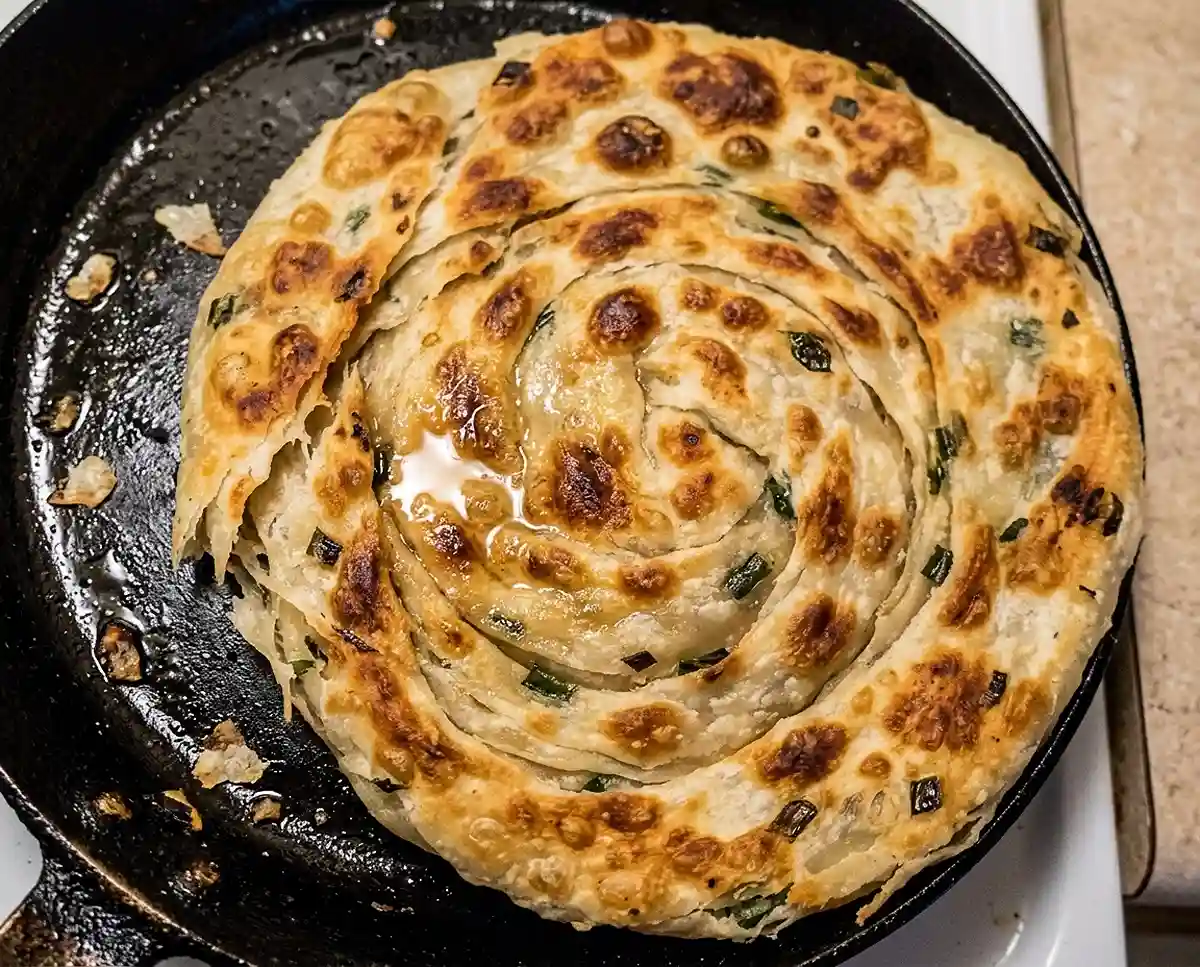
Taiwanese Green Onion Pancakes you can pull apart in thin, crackly sheets. Here’s my hot-water dough method, plus how to freeze the extras for later.
The first time I made Taiwanese green onion pancakes, I coiled one so badly it looked like a deflated cinnamon roll, and my partner ate it anyway. I stood at the stove with flour up to my elbows and decided the flaky, golden layers were worth every dirty dish. The dog got the wonky ends, so nothing went to waste.
Table of Contents
Why Taiwanese green onion pancakes keep earning a spot in my rotation
Here’s the thing about these pancakes: the magic is in the dough, not in some rare ingredient. You pour boiling water into the flour first, then add room temperature water, and that two-step mix gives you a dough that rolls out thin. I think it’s the most useful trick in the whole recipe.
Then comes the filling, which is spring onions, flour, salt, and hot fat poured over the top. Once it hits the onions, the whole kitchen smells like a street stall, and the dog suddenly appears at your ankles.
Rolling, coiling, and flattening is where the layers get made. You repeat the same moves six times, so by pancake three your hands know what they’re doing. Fair warning, the first one will probably look wonky, and it will still taste great.
A hot pan finishes the job. Covered with a lid for the first two minutes, the pancake cooks gently, and then you press and flip until the outside goes golden. That final squeeze between two spatulas is my favorite part, because the layers crackle under your hands.
Taiwanese Green Onion Pancakes with Flaky Layers Inside
Equipment
- Large mixing bowl
- wooden chopsticks or fork
- Stand mixer with dough hook (optional)
- Tea towel
- Heatproof bowl
- Small saucepan
- Silpat or work surface
- Rolling Pin
- Pastry brush
- frying pan with lid
- 2 spatulas
- Paper towels
- small bowl
Ingredients
For the Dough
- 4 cups Chinese all-purpose flour 575g; regular all-purpose or an all-purpose/cake flour mix works, but not 100% cake flour
- ½ teaspoon kosher salt
- 1 cup boiling water 237g
- ½ cup + 1 tablespoon room temperature water 132g; cold is fine
For the Filling
- 1-1 ½ cups spring onions sliced finely; thinner green part only, or halve the thicker white base lengthwise before slicing
- ½ cup Chinese all-purpose flour or regular all-purpose, cake flour or a mix
- ½ cup pork lard or shallot oil, neutral oil or butter
- 1 ½ teaspoons kosher salt
- ground Sichuan peppercorn or 5 spice powder optional
For Frying
- oil enough to coat the bottom of the pan
For the Dipping Sauce
- 2 tablespoons soy sauce
- 2 tablespoons rice vinegar or Chinkiang vinegar
- white sugar to taste
- 1 tablespoon sesame oil optional
- sliced spring onions optional, for garnish
- dry toasted sesame seeds optional, for garnish
Instructions
Make the Dough
- Mix the flour and salt in a large bowl. Make a well in the middle, pour in the boiling water and leave it for a few minutes. Add the room temperature water and stir with wooden chopsticks or a fork until a clumpy, sticky dough forms.
- When the dough is cool enough to handle, knead it by hand for about 5 minutes, until smooth and no longer sticky. You can also use a mixer with a dough hook on medium speed for 3-4 minutes. Shape it into a ball and cover the bowl with a tea towel to rest.
Make the Filling
- While the dough rests, put the sliced spring onions in a heatproof bowl. Heat the lard, oil or butter and carefully pour it over the onions, keeping back in case it splatters. Add the flour, salt and Sichuan pepper or 5 spice (if using), and mix well.
Shape the Pancakes
- Roll the rested dough into a log and cut it into 6 equal pieces. Keep the pieces you aren’t working with covered with a tea towel.
- On a Silpat or a floured or oiled surface, roll one piece with a floured or oiled rolling pin into a thin rectangle, as thin as you can without tearing it. Flip the dough every 1-2 rolls so it doesn’t stick, and pay attention to the thicker edges.
- Brush about 2 tablespoons of filling over the dough, leaving a 1 cm clear border. Roll it up into a long log. Hold one end and gently tap the log on the surface while pulling, so it stretches and thins.
- Pinch the ends closed to seal in the filling. Coil the log into a pinwheel and cover it with a tea towel. Repeat with the remaining 5 pieces.
- Working in the order you filled them, press each pinwheel into a flat disc with the back of your hand or the rolling pin.
Fry and Serve
- Heat enough oil to coat the bottom of a frying pan over medium-high heat. Lay a pancake in the pan, placing it away from you to avoid splashes. Nudge it to make sure it isn’t sticking, then cover and cook for 1 minute.
- Flip, cover and cook for another minute. Uncover, flip again and press it down. Cook uncovered for 3-4 minutes more, flipping 1-2 times as needed, until both sides are golden brown. Go by color rather than the clock.
- Squeeze the pancake between 2 spatulas to loosen the layers, then drain it on a paper towel. Repeat with the remaining pancakes.
- Stir all the dipping sauce ingredients together in a small bowl, tasting and adjusting the sugar. Cut the pancakes into wedges like a pizza and serve hot with the sauce.
Notes
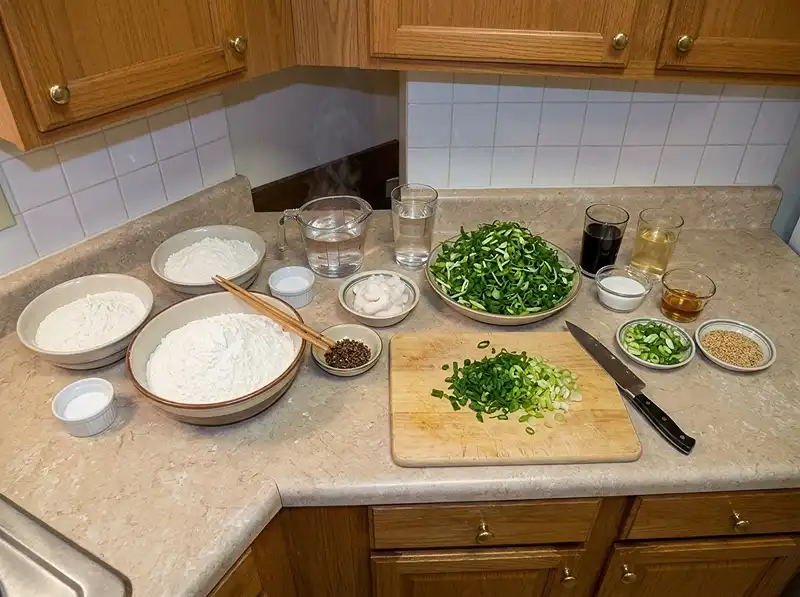
What goes in the bowl, and where I got picky
| What You’ll Need | How Much |
|---|---|
| For the dough | |
| Chinese all-purpose flour | 4 cups (575g) |
| Kosher salt | ½ teaspoon |
| Boiling water | 1 cup (237g) |
| Room temperature water (cold is fine) | ½ cup + 1 tablespoon (132g) |
| For the filling | |
| Sliced spring onions (thinner green part only, or halve the thicker white base before slicing) | 1-1½ cups |
| Chinese all-purpose flour | ½ cup |
| Pork lard | ½ cup |
| Kosher salt | 1½ teaspoons |
| Ground Sichuan peppercorn or 5 spice powder | Optional |
| For the dipping sauce | |
| Soy sauce | 2 tablespoons |
| Rice vinegar | 2 tablespoons |
| White sugar | To taste |
| Sesame oil | 1 tablespoon, optional |
| Sliced spring onions | Optional, for visual effect |
| Dry toasted sesame seeds | Optional, for visual effect |
I use Chinese all-purpose flour for these green onion pancakes because the recipe is built around it, and I’d rather not gamble on the dough. If you can’t find it, regular all-purpose flour works, or regular all-purpose mixed with cake flour. Skip 100% cake flour, though, since that’s the one swap I’d steer clear of.
The flour in the filling is more forgiving. Regular all-purpose, cake flour, or a mix of both all work there.
For the filling fat, I’m team pork lard. I’ve used butter and neutral oil when the lard ran out, and both worked, but I think lard tastes rounder and more savory. Shallot oil is the other swap, and it sounds like a good one if you keep it around.
Spring onions are where I got lazy once. Traditionally you use only the thinner green part, but if you hate waste, halve the thicker white base before slicing. I skipped that step last time, and one pancake split at the seam while it fried.
Ground Sichuan peppercorn or 5 spice powder is optional in the filling. I toss in a pinch of Sichuan peppercorn when I’m feeling bold, and my neighbor, who swears she hates anything scallion, still went back for a second pancake.
The dipping sauce is soy sauce, rice vinegar, and white sugar to taste, with sesame oil as an option. Chinkiang vinegar is the swap if you want a darker tang in place of rice vinegar. Sliced spring onions and dry toasted sesame seeds on top are only for visual effect, so skip them if the sink is already full.
How I make Taiwanese green onion pancakes, from dough to pan
Mix the dough with hot water first
Mix the flour and salt, then make a hole in the middle and pour the hot water in. Leave it for a few minutes, then pour in the room temperature water (cold works fine). Use a pair of wooden chopsticks or a fork to stir the dough together.
At this stage it’s clumpy and sticky, which looks wrong but isn’t. Hang in there, because the kneading is where it all comes together.
Knead until it stops sticking
Once the dough is cool enough to handle, knead it with your hands for about 5 minutes. You’ll know it’s done when it’s smooth and stops sticking. If your arms file a complaint, use a mixer with a dough hook on medium speed for about 3-4 minutes, until it forms a nice smooth ball.
Either way, roll the dough into a ball and cover the bowl with a tea towel so it doesn’t dry out. I once forgot the towel while chasing the dog out of the kitchen, and I came back to a crusty patch I had to pick off. Learn from me.
Make the spring onion filling while the dough rests
Use the dough’s resting time for the filling. Slice the spring onions finely, and if you’re adding the white part, cut it in half lengthwise first or the bits will be very thick. Put the spring onions in a heatproof bowl.
Heat the lard, oil, or butter, then carefully pour it over the spring onions. It may sizzle and splatter if the onions are wet, so keep your face back. The smell alone will pull everyone in the house into the kitchen. Add the flour, salt, and Sichuan pepper or 5-spice (if using), then mix well.
Divide and roll the dough
Divide the rested dough into 6 equal pieces. To keep them the same size, roll the whole ball into a log and cut it into 6 equal pieces. Some people weigh each piece, but I figure that’s overkill.
Take out 1 piece and place it on a Silpat or a floured or oiled surface. Keep the other 5 pieces covered with a tea towel while you work. Using a floured or oiled rolling pin, roll the dough into a thin rectangular piece.
Don’t worry if your shape is wonky. A rectangle gives you more equal, thin layers, but it isn’t a must for the recipe to work. Pay attention to the edges, since they tend to be thicker than the middle after rolling. Tip: I flip the dough after every 1-2 rolls so it doesn’t stick to the surface.
Brush on the filling and coil it up
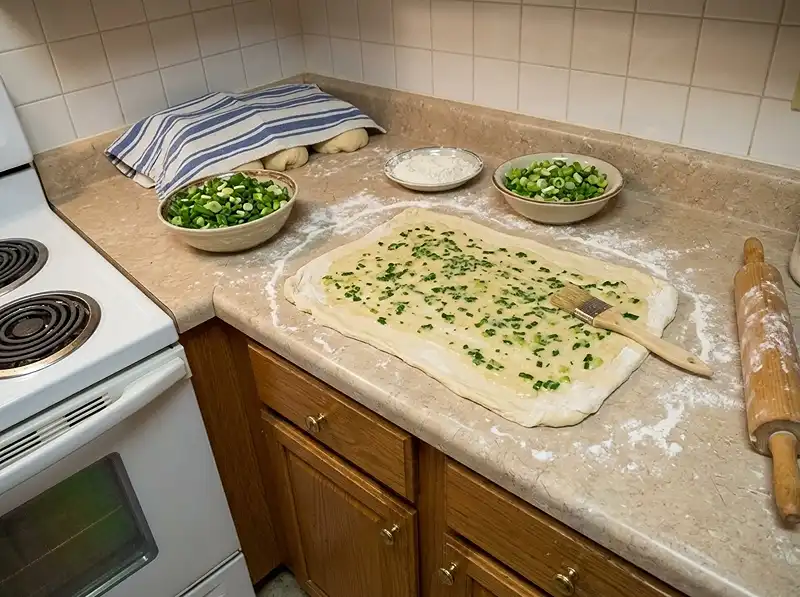
Once you’ve rolled the dough as thinly as possible without breaking, brush on about 2 tablespoons of filling with a pastry brush or the back of a spoon. Leave a 1 cm clear border so the filling doesn’t ooze out later. Then roll the brushed dough into a long log.
Pick up one end of the log and gently tap it on the surface while gently pulling. This stretches and relaxes the dough, so the layers get even thinner. My teenager calls this move weird but hovers to watch every single time.
Pinch the ends together so the spring onions stay inside, then coil the log into a pinwheel, like a seashell or snail shell, and cover it with a tea towel. Repeat the process with the other 5 pieces of dough.
Rest, then flatten
The coiled pancakes need to rest before you flatten them, so work in the same order you filled them. Those first coiled pieces have had more time to rest.
Place a pinwheel on the Silpat or a floured or oiled surface, then use the back of your hand or the rolling pin to gently press it into a flat disc. Repeat for all 6 pinwheels.
Fry until golden brown
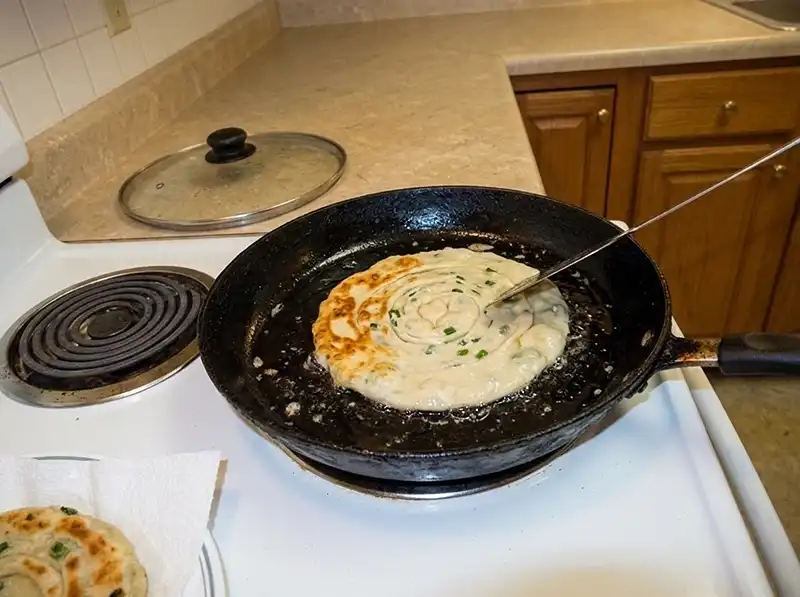
Add enough oil to coat the bottom of the frying pan and heat it on medium high heat. You can use more or less if you like, because less oil is healthier but more is tastier.
When the oil is hot, gently place 1 pancake in the pan, laying it down in the direction away from you so the hot oil doesn’t splash you. Nudge it with the spatula to make sure it hasn’t stuck, then cover with the lid for 1 minute.
Uncover, flip the pancake, and cook covered for another minute. Then remove the cover, flip it, and press it down so it browns evenly. Keep cooking uncovered for another 3-4 minutes, flipping 1-2 more times if needed, until both sides are golden brown.
Your stove may run hotter than mine, so trust the color more than the clock. My partner hovers by the paper towels right about now, and fair enough.
Before it leaves the pan, give each pancake a squeeze between 2 spatulas to loosen up the interior layers and make them flakier. Place it on a paper towel to absorb the excess oil, then repeat with the rest of the pancakes.
1-1.5 pancakes per person is usually enough, so if you don’t need that many, wrap the extras individually in plastic wrap or parchment paper and refrigerate or freeze them.
Stir the sauce and serve
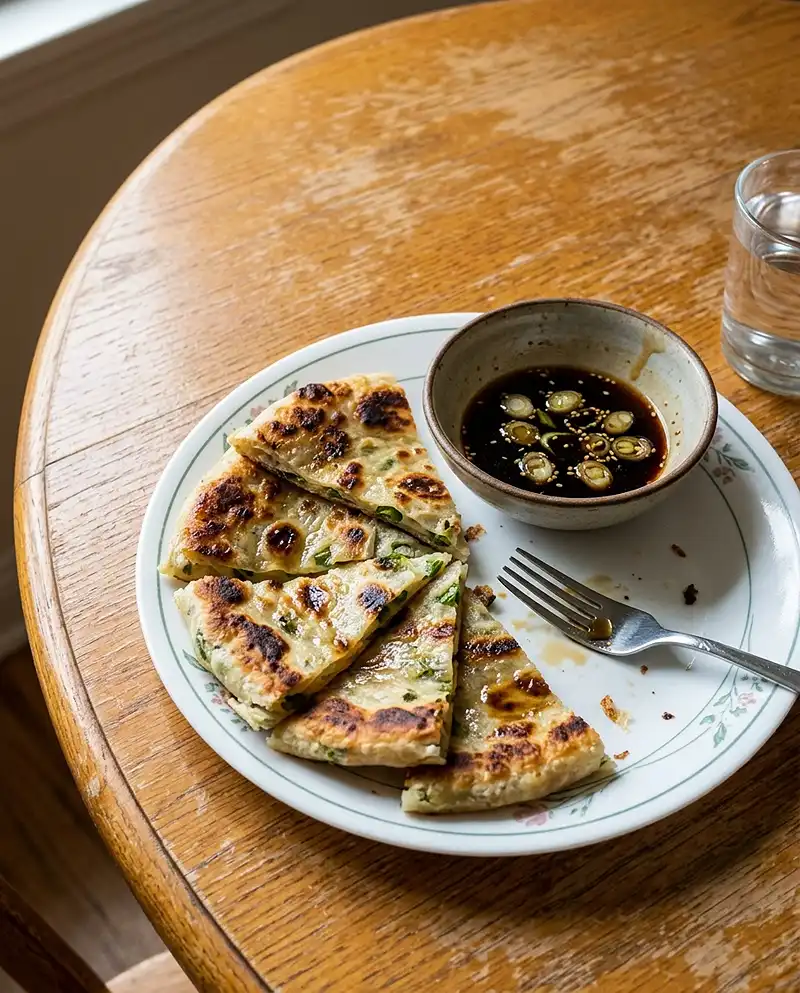
Add all the sauce ingredients to a small bowl and stir well. Serve the pancakes as a central dish, or give each person one. If you’re putting them in the middle of the table, cut them into smaller pieces, like a pizza, so they’re easier to serve.
Swaps, shortcuts, and what to do when it goes sideways
Hand kneading versus a mixer comes down to how your arms feel. By hand, you get a real sense of when the dough turns smooth and stops sticking. The mixer saves your wrists, but you’re watching the clock instead of the dough.
Cutting the dough from a log is quicker, while weighing each piece on a scale gets you identical pieces. I’ve never bothered with the scale, and mine come out close enough.
Ground Sichuan peppercorn and 5 spice powder are both optional in the filling, so you’re choosing a flavor, not following a rule. Sichuan leans tingly, while 5 spice leans warm and sweet. Honestly, plain is good too.
Taste the dipping sauce before you commit. Sugar goes in to taste and sesame oil is optional, so I stir, dip a scrap of pancake, and adjust. Side note, if you want a different kind of morning, my spinach cottage cheese oat pancakes head in a very different direction.
If it didn’t come out right
If a pancake burst at the seams, the thick white bits of spring onion probably weren’t halved before slicing. Next time, cut them in half first, and keep that 1 cm clear border around the filling so nothing oozes out.
If the layers feel dense, the dough may not have been rolled thin enough, or the tap-and-pull stretch got skipped. Leaving out the spatula squeeze at the end costs you some flakiness too.
If a pancake stuck, flip the dough after every 1-2 rolls and flour or oil the rolling pin and surface. Should it tear, stop rolling once the dough is as thin as it can get without breaking. For uneven color, flip the pancake 1-2 more times and press it down.
Keeping leftover Taiwanese green onion pancakes around
| Where | How | Keeps For |
|---|---|---|
| Room temperature | Leave out only while serving, then wrap and refrigerate the rest | Up to 2 hours |
| Fridge | Wrap each pancake individually in plastic wrap or parchment paper | 3 to 4 days |
| Freezer | Wrap each pancake individually in plastic wrap or parchment paper, then freeze | About 2 to 3 months for best quality |
I wrap each leftover pancake on its own, so they never weld together in the fridge or freezer. Those times follow USDA guidance on leftovers and food safety.
To reheat, warm a pancake in a skillet over medium heat, flipping it until it’s hot all the way through and the edges crisp up again. Frozen ones should thaw in the fridge first. Leftovers should reach 165°F in the center, and FoodSafety.gov has the details.
A reheated pancake torn into pieces is good for dunking in soup, and a fried egg folded inside makes a quick breakfast. My partner insists on eating the cold ones standing at the open fridge, and I’ve given up arguing.
Questions I get asked a lot
Can I use regular all-purpose flour for green onion pancakes?
Yes. Regular all-purpose flour works in place of Chinese all-purpose flour, and so does regular all-purpose mixed with cake flour. Just don’t use 100% cake flour for the dough.
What can I use instead of pork lard in the filling?
Shallot oil, neutral vegetable oil, or butter all work as swaps. Lard is what I use, but you heat and pour whichever fat you pick over the spring onions the same way. Mix in the flour, salt, and optional spice, and you’re set.
Can I make the dough in a mixer?
Yes. Use a dough hook on medium speed for about 3-4 minutes, until it forms a nice smooth ball. Then roll it into a ball and cover the bowl with a tea towel.
Why did my pancake burst at the seams?
The thick white base of the spring onions is the usual suspect. Cut those pieces in half before slicing so the bits aren’t too thick, and leave a 1 cm clear border around the filling. Pinch the ends together before you coil the log.
How many pancakes does each person need?
1-1.5 pancakes per person is usually enough. The dough divides into 6 pancakes, so one batch covers roughly four to six people.
Your turn to get flour everywhere
Go make a batch and tell me how it went. Save the recipe to Pinterest so you can find it the next time the craving hits, and leave a comment or star rating below with your results.
If you land on a sweeter pancake mood another day, my fluffy Japanese soufflé pancakes are a very different kind of fun.
When you serve them, stir the sauce first, then cut each hot pancake into wedges like a pizza and set them in the middle of the table.