
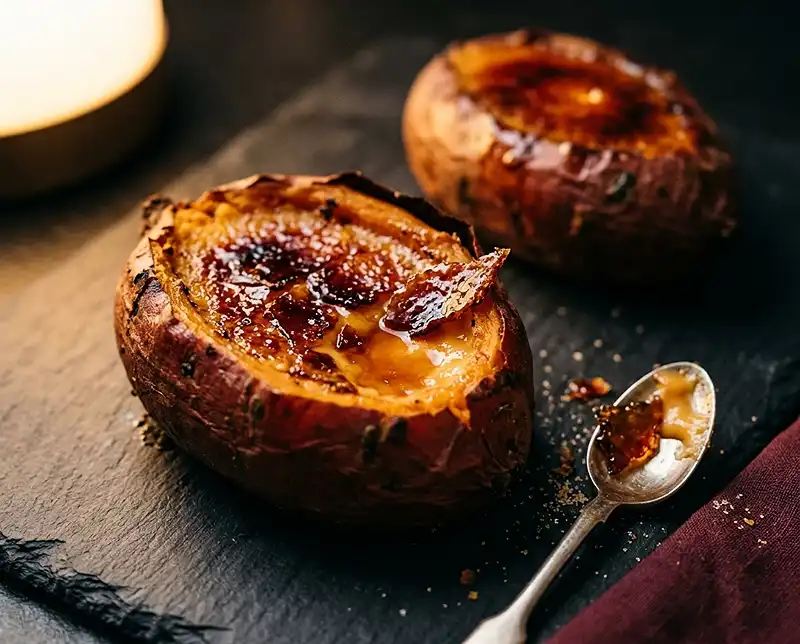
Cool, silky custard you scoop from its own skin. This crème brûlée sweet potatoes recipe has a ramekin route too. Here’s how I make it, plus how to torch it.
The first time I made this crème brûlée sweet potatoes recipe, my partner cracked the sugar with a spoon, went quiet, and then asked where the rest of them were hiding. I’d mostly wanted to find out whether a sweet potato skin could hold custard without springing a leak. It can, with one small repair trick I’ll get to.
Table of Contents
Why this crème brûlée sweet potatoes recipe earns a spot in the rotation
Here’s the thing: the sweet potato does double duty. It’s the bowl, and it’s also what keeps the custard from tasting like plain vanilla. Half a cup of puree goes in with the yolks, sugar, cream, and milk, and the cinnamon pushes everything toward fall without turning it into a pie.
The real trick is contrast. Under a thin sheet of burnt sugar sits a cold, smooth custard, and the spoon makes that little cracking sound before it hits the soft stuff. Honestly, that crack is half the reason I make it.
Fair warning, there are two ways to go. You can bake the custard right inside the hollowed-out sweet potatoes, or you can bake it in ramekins and use the sweet potato only for the puree. I’ll cover both below, so if you’ve been hunting for a sweet potato crème brûlée recipe without the hollowing-out part, the ramekin steps are yours.
Crème Brûlée Sweet Potatoes Recipe with Crackly Sugar Tops
Equipment
- Large baking pan
- Parchment paper
- fork
- Spoon
- Large pitcher or measuring cup
- Blender (optional)
- ramekins (optional)
- Kitchen torch
Ingredients
For the Shells
- 6 large sweet potatoes washed, not peeled (use 1 for the ramekin version)
For the Custard
- 6 large egg yolks
- ⅓ cup granulated sugar
- ½ cup sweet potato puree from the baked sweet potatoes
- ⅛ teaspoon sea salt
- 1 teaspoon cinnamon
- 1 tablespoon pure vanilla extract
- 1 cup heavy whipping cream
- 1 cup milk
For the Top
- 4-6 teaspoons granulated sugar 1 to 2 teaspoons per crème brûlée
Instructions
Sweet Potato Shell Version
- Preheat the oven to 375°F (190°C) and line a large baking pan with parchment paper. Poke holes in the top of each sweet potato with a fork and bake for 45 to 55 minutes, until soft. Let them cool until you can handle them.
- Press the top of each potato to flatten it slightly, then cut off the top piece of skin. Scoop out most of the flesh, leaving about ½ inch all around. If you tear a hole, patch it with a little mashed flesh. Mash or blend ½ cup of the scooped flesh into a puree.
- In a large pitcher, stir the egg yolks, sugar and sweet potato puree until smooth. Add the sea salt, cinnamon, vanilla, cream and milk, and stir to combine.
- Pour the custard into the hollowed-out sweet potatoes (bake any extra in a ramekin). Bake at 340°F (170°C) for 20 to 25 minutes, until the edges are set and the center is still wiggly.
- Let them cool completely, then refrigerate for 2 to 4 hours or overnight, until set.
Ramekin Version
- Bake 1 sweet potato at 375°F (190°C) for 45 to 55 minutes, until soft. Let it cool, then mash or blend it into a puree.
- In a large pitcher, stir the egg yolks and sugar until smooth. Add the sea salt, cinnamon, vanilla, ½ cup sweet potato puree, cream and milk, and stir to combine.
- Pour into 4 to 6 ramekins and set them in a tall-sided baking pan. Pour boiling water into the pan around the ramekins. Bake at 340°F (170°C) for 18 to 22 minutes, until the edges are set and the center is still wiggly.
- Let them cool completely, then refrigerate for 2 to 4 hours or overnight, until set.
Sugar and Torch
- Right before serving, sprinkle 1 to 2 teaspoons of sugar evenly over each custard. Melt and caramelize it with a kitchen torch, keeping the flame away from the sweet potato skins. Let the sugar harden, then serve right away.
Notes
What to grab before you start
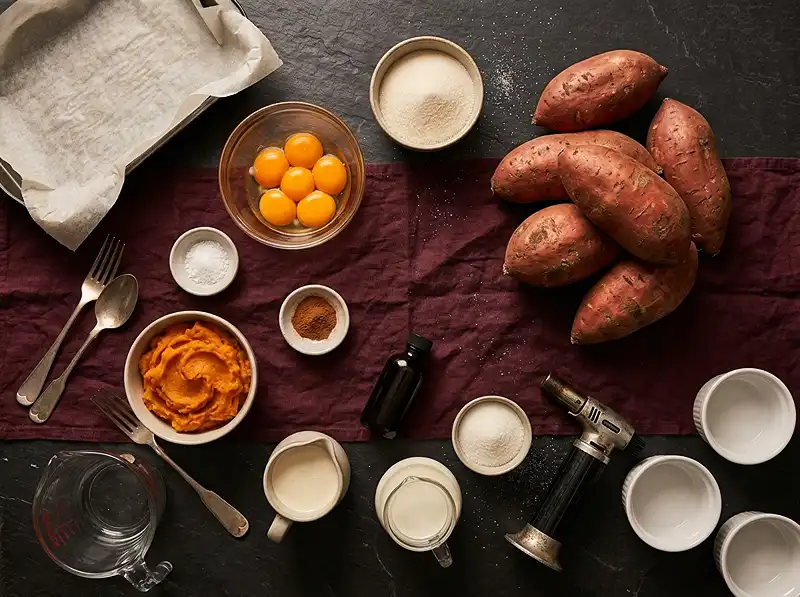
| What You’ll Need | How Much |
|---|---|
| For the shells | |
| Sweet potatoes, washed and not peeled | 6 large |
| For the custard | |
| Egg yolks | 6 large |
| Granulated sugar | ⅓ cup |
| Sweet potato puree | ½ cup |
| Sea salt | ⅛ teaspoon |
| Cinnamon | 1 teaspoon |
| Pure vanilla extract | 1 tablespoon |
| Heavy whipping cream | 1 cup |
| Milk | 1 cup |
| For the top | |
| Granulated sugar | 4-6 teaspoons |
Leave the skins on and give the potatoes a good scrub, since they’re doing bowl duty. I look for sweet potatoes that are about the same size, because a lopsided one bakes at its own speed and you end up guessing.
Spend your money on the vanilla. There’s so little else going on in the custard that real, pure extract shows up in every bite, and I’ve never regretted the extra couple of dollars. For the heavy whipping cream, honestly, the store brand does the job, because it’s getting stirred with yolks and milk and chilled hard anyway.
The sea salt is only ⅛ teaspoon, which sounds like nothing, but it keeps all that sweetness from tasting flat. Granulated sugar is all you need on top, and a torch melts plain white sugar fast. Whatever you do, keep that topping sugar out of the custard.
How to build it, start to finish

Bake the Sweet Potatoes
Preheat the oven to 375°F (190°C), line a large baking pan with parchment paper, and set the sweet potatoes on it. Poke holes in the top of each one with a fork, because that gives the steam somewhere to go. Bake for 45-55 minutes, until a fork slides in soft, then set them aside until they’re cool enough to handle. If you’re going the ramekin route, skip down to the ramekin steps.
Hollow Them Out
Press down on top of each potato with your hands to flatten the top a little, then cut off that top piece of skin and toss it. Use a spoon to carefully scoop out most of the flesh, leaving about ½” all the way around, like a bowl. Measure out ½ cup from the excess and mash it with a fork or blend it into a puree.
Last time I scraped too hard and wore a hole clean through the side. Don’t panic if you do the same, because you can patch it with a little mashed sweet potato flesh pressed into shape. Set the shells and the puree aside.
Stir Together the Custard
In a large pitcher or measuring cup, combine the egg yolks, sugar, and sweet potato puree, and stir until smooth. I use a pitcher with a spout, since pouring into a thin-walled potato from a mixing bowl gets messy fast.
Next, add the sea salt, cinnamon, vanilla extract, heavy whipping cream, and milk, and stir to combine. The mixture smells like cinnamon and warm vanilla before it’s even been near the oven.
Pour, Bake, and Chill
Pour the custard into the hollowed-out sweet potatoes. If you have extra mixture, bake it in a ramekin (the ramekin steps are just below). Bake at 340°F (170°C) for 20-25 minutes, until the edges are set and the center is still wiggly. That timing can run longer or shorter depending on how big your sweet potatoes are, and your oven may run hotter than mine, so start checking early.
Let them cool completely, then refrigerate until set, 2 to 4 hours or overnight. Resist the urge to poke them every twenty minutes.
If You’re Using Ramekins Instead
Bake one sweet potato in an oven preheated to 375°F (190°C) until it’s soft and squishy, about 45 to 55 minutes. Let it cool, then mash it with a fork or run it through a blender.
In a large pitcher or measuring cup, combine the egg yolks and sugar and stir until smooth. Then add the sea salt, cinnamon, vanilla extract, sweet potato puree, heavy whipping cream, and milk, and stir to combine. Yes, the puree goes in later this time, and that’s the only real difference in the mixing.
Pour the mixture into 4-6 ramekins and set them in a larger baking pan with tall edges. Next, pour boiling water into the pan around the ramekins, not into them. That water bath keeps the custard cooking gently, so the edges don’t get a head start on the center.
Bake at 340°F (170°C) for 18-22 minutes, until the edges are set and the center is still wiggly. Let them cool completely, then refrigerate until set, 2 to 4 hours or overnight.
Sugar the Tops and Torch Them
Sprinkle one to two teaspoons of granulated sugar on top of each crème brûlée and spread it to cover liberally, since any bare spot stays pale. Just before serving, use a kitchen torch to melt and burn the tops, carefully, and keep the flame off the sweet potato skins. You’ll smell caramel almost right away, and the sugar goes amber and then glassy.
The broil setting works as a backup, but I don’t recommend it for the ones made inside sweet potatoes, because the skin might light on fire. Ramekins are fine under the broiler. Let the sugar set, then serve immediately!
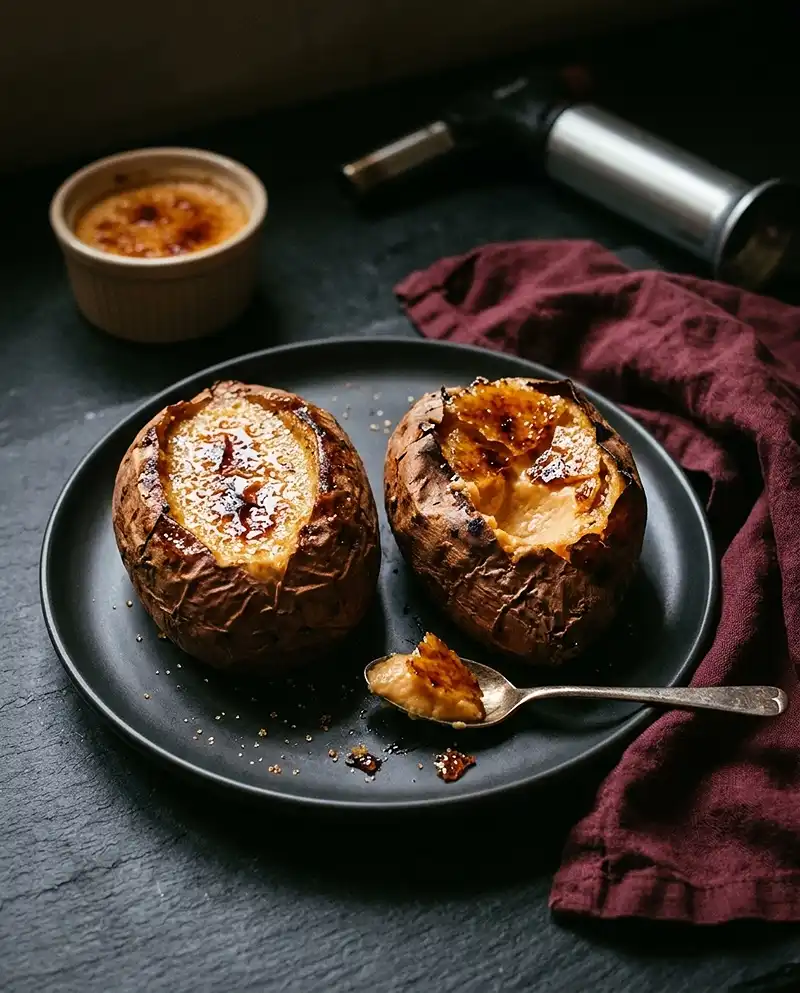
Tips, swaps, and what to do when your crème brûlée sweet potatoes recipe misbehaves
Little Things That Help
Pick shells that stand upright on their own, and nudge the filled ones against each other in the pan so they don’t tip. Slightly annoying, but a tipped potato means custard on the oven floor.
If you don’t own a torch, the broiler is the optional swap for ramekins. It’s handier since you already own it, but you lose control of the browning, so stay at the oven door.
On the shells versus ramekins question, I’ll be honest. The shells look great on the table and skip the ramekin washing, but the walls are thin and the skin can catch fire. Ramekins take the pressure off, and the water bath is forgiving.
Side note, if dessert follows a bigger dinner, a Mississippi pot roast or a pan of crispy parmesan accordion potatoes fits nicely. Since the custards can chill overnight, you only have to torch them at the end. An optional variation, and not part of the recipe: dust a tiny pinch of extra cinnamon over the sugar before you torch.
If It Didn’t Come Out Right
If the center is still loose after chilling, give it more time in the fridge. I once tried to torch a batch after barely an hour because company showed up early, and the sugar slid right off the soft custard. Plan on 2 to 4 hours or overnight, and don’t rush it.
If the edges look puffed or scrambled, your oven probably ran hot. Next time, pull them when the edges are set and the center still wiggles, and start checking early, since the size of the sweet potato changes the timing.
Patchy, pale sugar means the layer was thin or uneven. Spread it to cover liberally before you torch, and keep the flame moving. If a skin starts smoking, pull the flame away and blow it out, because the skin is the one part you don’t want browned.
Leftovers, if you somehow have any
Cover the chilled custards and keep them in the fridge before you sugar them, since the topping is a just-before-serving job. For storage times I follow the USDA Food Safety and Inspection Service guidance on leftovers, which is why I don’t push past three days.
| Where | How | Keeps For |
|---|---|---|
| Fridge, before torching | Covered, with no sugar on top yet | Up to 3 days |
| Fridge, after torching | Covered loosely, and expect the top to soften | Up to 3 days |
| Room temperature | Not recommended for custard | No more than 2 hours |
| Freezer | Not recommended, since the texture turns watery | Skip it |
Don’t bother reheating, since these are a cold dessert. If the sugar went soft overnight, add another thin layer and torch it again right before serving.
The extra scooped-out sweet potato (there’s usually some) is good stirred into oatmeal or mashed onto toast with butter. A ramekin of extra custard makes a solid cook’s snack the next day.
Questions that come up a lot
Can I make this sweet potato crème brûlée recipe without a kitchen torch?
Yes, with the broil setting, but only for the ramekin version. I don’t recommend it for custard baked inside the sweet potatoes, because the skin might light on fire. Whatever you use, watch it the whole time, since sugar goes from amber to burnt fast.
Do I have to bake it inside the sweet potatoes?
Nope. Bake one sweet potato for the puree, pour the custard into 4-6 ramekins, and set them in a water bath in a tall-edged pan. It’s the calmer route, and the broiler is fair game for the top.
How far ahead can I make it?
Bake and chill the custards for 2 to 4 hours or overnight, and wait to sugar and torch them until just before serving. Covered in the fridge, they keep up to 3 days, which lines up with the leftover guidance on FoodSafety.gov. The top is best fresh, though.
Can I freeze leftovers?
I wouldn’t. Custard tends to turn watery once it thaws, and the sugar top won’t survive the trip either. Plan to eat them within those 3 days instead.
How do I know the custard is done baking?
Look for edges that are set and a center that’s still wiggly. That takes 20-25 minutes in the sweet potatoes, though the size of the potato changes it, or 18-22 minutes in ramekins. It firms up as it chills, so the wiggle is normal. Because it’s an egg-based dessert, I keep it cold and check the FDA’s food safety guidance when I’m unsure.
Go make it, then tell me how it went
Make a batch of this crème brûlée sweet potatoes recipe, save it to Pinterest so it’s waiting when the next cold night rolls around, and leave a comment or a star rating once the first top cracks. I’d like to know whether you went with the shells or the ramekins. Honestly, I still can’t decide which one I like more.
Last tip: bake and chill the custards the day before, then sugar and torch them right before serving so the top cracks like it should.