
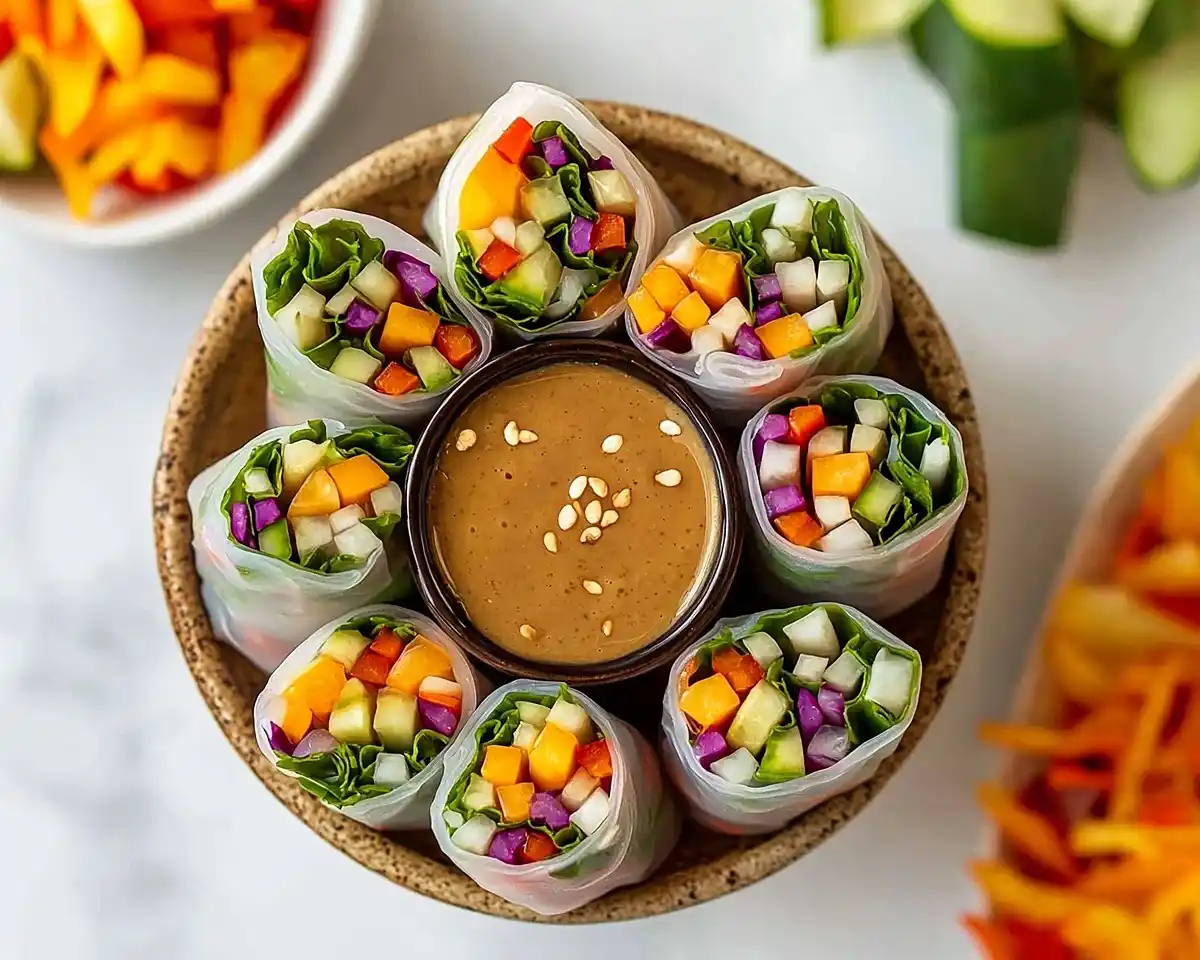
Fresh vegan spring rolls packed with crisp vegetables, mint, and creamy peanut sauce. Easy 15-minute recipe with tofu options and storage tips.
Hey, I’m Sofia! Welcome to Tasty at Home, where cooking is supposed to be fun, not scary.
These fresh vegan spring rolls? They changed my entire relationship with quick dinners. I first made them during a sweltering July afternoon when turning on the stove felt impossible. Now they’re my go-to when I need something light, fresh, and ridiculously satisfying.
The crunch of raw vegetables wrapped in delicate rice paper, the cool mint, the creamy peanut sauce—it’s like summer on a plate. No cooking required. Just assembly, creativity, and about 15 minutes of your time.
Tasty at Home – Where bold flavors meet everyday kitchens.
Table of Contents
What Makes These Spring Rolls Special
Traditional Vietnamese summer rolls inspire this recipe, but I’ve adapted it for the American home cook who wants maximum flavor with minimum fuss. The key lies in the vegetable selection and that irresistible peanut dipping sauce.
Unlike deep-fried egg rolls, these fresh vegan spring rolls stay light and healthy. The rice paper becomes translucent when wet, creating a beautiful window to the colorful vegetables inside. You’ll love how the textures play together—crisp carrots, tender spinach, smooth tofu.
I’ve tested this recipe over twenty times to nail the perfect vegetable-to-wrapper ratio. Too much filling and the wrapper tears. Too little and you’re basically eating wet paper.
Fresh Vegan Spring Rolls
Equipment
- Sharp knife
- Cutting board
- Large shallow dish
- Small whisk or fork
Ingredients
Spring Rolls
- 8 wrappers rice paper wrappers Asian food aisle
- 1 medium carrot thinly sliced
- 0.5 cup red cabbage shredded
- 0.5 red bell pepper thinly sliced
- 0.5 yellow bell pepper thinly sliced
- 4 inch piece cucumber julienned, English cucumber preferred
- 2 green onions thinly sliced
- 1 cup spinach or lettuce shredded
- 1 handful fresh mint leaves shredded
- 0.5 pack smoked tofu optional, sliced thin
Peanut Sauce
- 2 tablespoons peanut butter natural style
- 0.5 tablespoon soy sauce or tamari
- 0.5 tablespoon maple syrup
- 1 tablespoon sesame oil or neutral oil
- 1 tablespoon water to thin sauce
- 1 teaspoon rice vinegar or apple cider vinegar
Instructions
- In a small bowl, whisk together peanut butter, soy sauce, maple syrup, oil, water, and vinegar until smooth and creamy. Set aside.
- Thinly slice all vegetables and tofu. Arrange them in separate bowls for easy assembly.
- Fill a large shallow dish with warm water. Dip one rice paper wrapper into the water for about 5 seconds per side, then place it on a cutting board.
- Place a small amount of vegetables, mint, and tofu on the lower third of the wrapper, leaving space at the edges.
- Fold the bottom edge over the filling, fold in both sides, and roll tightly upward to seal.
- Repeat with remaining wrappers and fillings. Serve immediately with peanut dipping sauce.
Notes
Ingredient Quality Matters
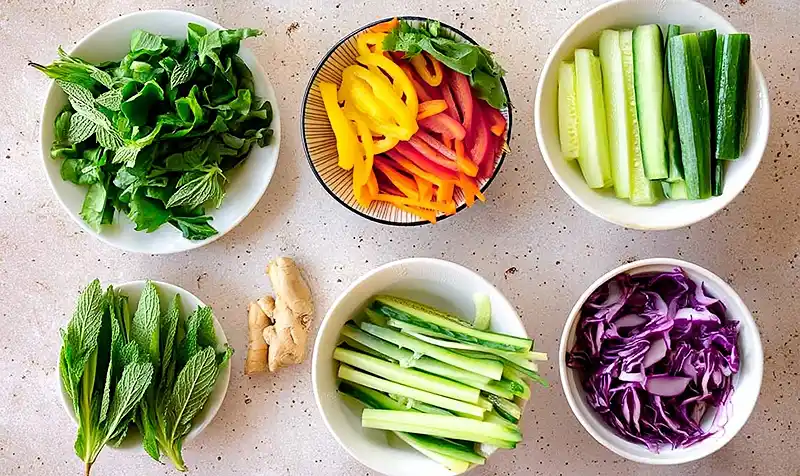
For the crispest results, select vegetables at their peak freshness. Choose carrots that snap rather than bend. Pick bell peppers with smooth, unblemished skin and firm flesh. Your mint should smell intensely aromatic—those pre-packaged containers at the grocery store often work great.
The peanut butter forms the sauce foundation, so quality counts. Natural peanut butter creates a richer, more authentic flavor than the sweetened varieties. Look for brands with just peanuts and salt listed in the ingredients.
Ingredients Table
| Ingredient | Amount | Metric | Notes |
|---|---|---|---|
| Rice paper wrappers | 8 wrappers | 8 wrappers | Find in Asian food aisle |
| Medium carrot | 1, thinly sliced | 1, thinly sliced | Use a mandoline for uniform cuts |
| Red cabbage | ½ cup shredded | 60g | Adds gorgeous purple color |
| Red bell pepper | ½, thinly sliced | ½, thinly sliced | Choose firm, glossy peppers |
| Yellow bell pepper | ½, thinly sliced | ½, thinly sliced | Sweet and colorful |
| Cucumber | 4-inch piece | 10cm piece | English cucumber works best |
| Green onions | 2, thinly sliced | 2, thinly sliced | Use both white and green parts |
| Spinach or lettuce | 1 cup shredded | 30g | Baby spinach is easiest |
| Fresh mint leaves | 1 handful, shredded | 10g | Don’t skip this! |
| Smoked tofu (optional) | ½ pack (90g) | 90g | Crispy tofu or tempeh work too |
| Peanut Sauce | |||
| Peanut butter | 2 tablespoons | 32g | Natural style preferred |
| Soy sauce/tamari | ½ tablespoon | 7ml | Tamari for gluten-free |
| Maple syrup | ½ tablespoon | 7ml | Balances the salt |
| Neutral or sesame oil | 1 tablespoon | 15ml | Sesame adds nutty depth |
| Water | 1 tablespoon | 15ml | Thins the sauce |
| Rice or apple cider vinegar | 1 teaspoon | 5ml | Adds brightness |
Shopping Tips for US Stores
Rice paper wrappers hide in the international aisle at most major grocery chains. Whole Foods, Trader Joe’s, and Asian markets stock multiple brands. Spring roll wrappers and summer roll wrappers are the same product—don’t let the names confuse you.
Can’t find smoked tofu? Regular extra-firm tofu works perfectly. Press it for 15 minutes, then pan-fry in a little oil until golden. This protein-rich preparation technique transforms bland tofu into something special.
Smart Substitutions
For the vegetables: Swap in whatever looks freshest at your market. Shredded purple cabbage, julienned zucchini, thinly sliced radishes, or bean sprouts all work beautifully. Avocado slices add creaminess, while mango brings unexpected sweetness.
For the sauce: Almond butter or cashew butter replace peanut butter seamlessly. Coconut aminos substitute for soy sauce if you’re avoiding soy. Honey can stand in for maple syrup, though it’s not strictly vegan.
For international readers: Rice paper is available globally in Asian grocers. Use grams for precise measuring. Substitute local fresh herbs like cilantro, basil, or Thai basil for mint.
Essential Equipment
You need surprisingly little equipment for these fresh vegan spring rolls. A sharp knife, cutting board, and large plate are the essentials. A mandoline slicer speeds up prep dramatically, but careful knife work achieves the same results.
Large shallow dish or plate: This holds your warm water for dipping rice paper. A pie plate works perfectly. The wider the vessel, the easier the dipping process.
Sharp chef’s knife: Thin, uniform vegetable slices are crucial. Dull knives crush vegetables instead of cleanly slicing them. Well, if you’re like me and hate sharpening knives, those pull-through sharpeners from the grocery store work in a pinch.
Small whisk or fork: For mixing the peanut dipping sauce. No fancy equipment needed here.
Step-by-Step Instructions
Step 1: Prepare Your Peanut Dipping Sauce
Add all peanut sauce ingredients to a small bowl. Whisk vigorously until completely smooth and creamy, about 30 seconds. The mixture should coat the back of a spoon without running off immediately.
Set the sauce aside at room temperature. It will thicken slightly as it sits, which is exactly what you want. If it becomes too thick before serving, add water one teaspoon at a time until you reach your preferred consistency.
Step 2: Prep Your Vegetables
Slice all vegetables as thinly as possible for the best rolling experience. Thick chunks tear the delicate rice paper. Use a mandoline on the thinnest setting if you have one, or practice your knife skills.
Arrange everything in separate small bowls near your workspace. This mise en place approach—as Julia Child always emphasized—makes assembly infinitely smoother. You’ll thank yourself when you’re not frantically searching for the mint mid-roll.
One mistake I made early on? Cutting vegetables hours ahead. They dried out and lost their snap. Prep them no more than 30 minutes before assembly for maximum crunch and vibrant color.
Step 3: Set Up Your Rolling Station
Pour warm water onto your large plate or shallow bowl. The water should feel comfortably warm to your touch—not hot, not cold. Hot water makes the wrappers too sticky and fragile. Cold water won’t soften them properly.
Keep your cutting board or clean work surface directly beside the water dish. Have a clean, slightly damp kitchen towel nearby to wipe your hands between rolls.
Step 4: Hydrate Your First Rice Paper
Submerge your first rice wrapper completely in the warm water. After exactly 5 seconds, flip the wrapper over and dip the other side. Immediately remove it and place it on your cutting board.
The wrapper will still feel slightly stiff when you remove it—that’s perfect. It continues softening as you add the filling. Thomas Keller teaches that patience with hydration prevents soggy, torn wrappers.
Step 5: Add Your Filling
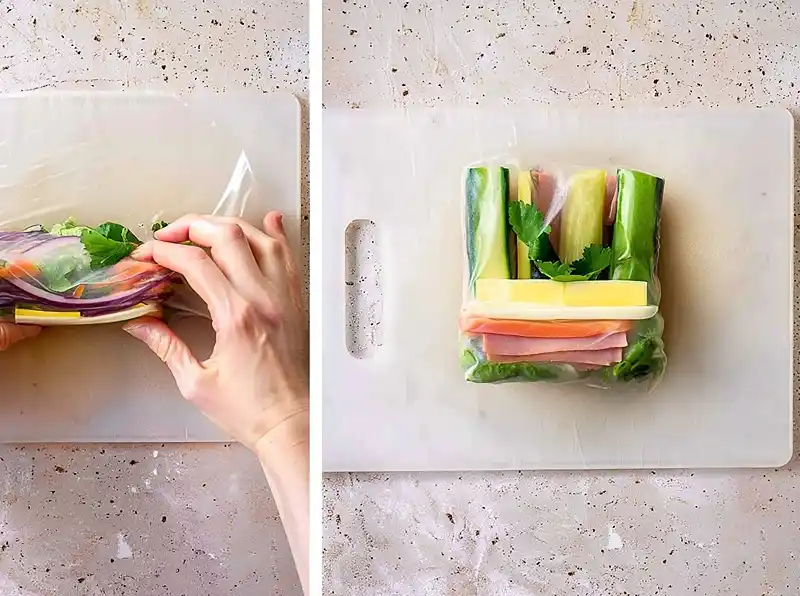
Place your thinly sliced vegetables, mint leaves, and tofu (if using) on the lower third of the rice wrapper. Keep all filling at least 1 inch away from the bottom edge. This buffer zone prevents ingredients from falling out during rolling.
Don’t overstuff! This is the most common beginner mistake. Three to four thin slices of each vegetable is plenty. You want to see the vegetables through the translucent wrapper, not bulge out the sides.
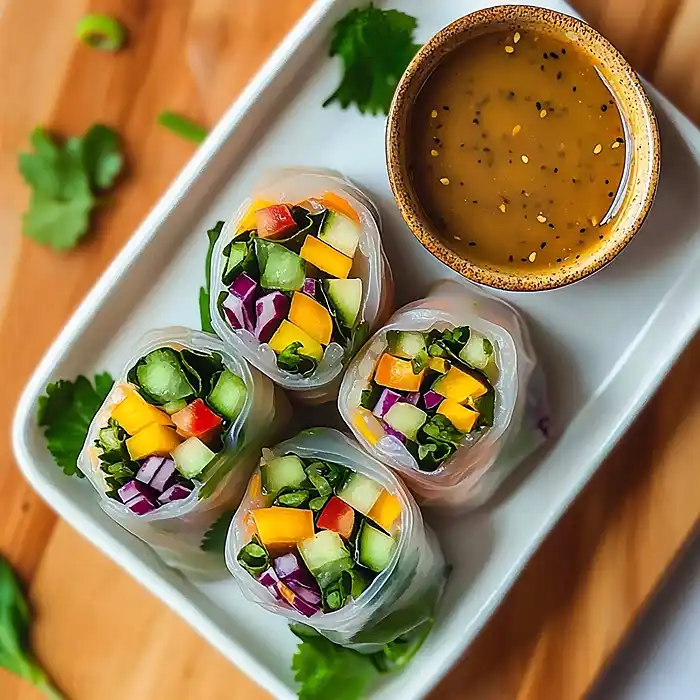
Arrange colorful vegetables strategically so they show through the wrapper. Red cabbage, yellow pepper, and green cucumber create an Instagram-worthy rainbow effect.
Step 6: Roll Tight and Secure
Fold the bottom edge of the wrapper up and over the filling until the ingredients are just covered. Use your fingers to tuck everything tightly toward the center as you roll—loose rolls fall apart when you bite them.
Fold the left side over the center, then fold the right side over. Keep tension as you fold to prevent gaps. Continue rolling from the bottom toward the top edge until the spring roll is completely sealed.
The rice paper sticks to itself naturally, creating a perfect seal. No toothpicks or tricks needed here.
Step 7: Repeat and Serve
Complete the same process with all remaining wrappers. You’ll get faster with each roll—my first one always takes twice as long as my eighth. The rhythm becomes natural.
Optionally slice each roll in half diagonally to display those gorgeous colorful veggies inside. Arrange them on a large platter with the peanut dipping sauce in a small bowl at the center. Serve immediately for the best texture, or refrigerate covered with a damp paper towel for up to 2 hours.
Expert Tips for Perfect Spring Rolls
Keep wrappers moist but not wet. If your wrapper sits too long after hydrating, it becomes gummy and difficult to work with. Work quickly but calmly. If a wrapper does dry out, a quick spray with water from a misting bottle revives it.
Layer strategically for beauty. Place your most colorful vegetables—red cabbage, yellow pepper, fresh herbs—on the bottom layer where they’ll show through the translucent wrapper. This technique elevates presentation from home-cook to professional.
Make sauce variations. The basic peanut sauce is phenomenal, but try adding sriracha for heat, lime juice for brightness, or minced garlic for depth. A tablespoon of hoisin sauce creates an authentic Vietnamese flavor profile many Americans love.
Prevent sticking on the platter. Fresh vegan spring rolls stick together when touching. Lay them seam-side down with a half-inch gap between each roll, or separate layers with parchment paper. This simple step keeps them pristine until serving.
Creative Variations to Try
Thai-Inspired Version: Add fresh basil and cilantro instead of mint. Include vermicelli rice noodles for heartiness. Serve with a sweet chili sauce mixed with lime juice—a combination that’ll make your taste buds dance.
Rainbow Summer Rolls: Use purple cabbage, orange bell pepper, yellow mango, green cucumber, and red tomato for every color of the rainbow. Kids especially love these, and they’re perfect for Pride celebrations or summer parties.
Protein-Packed Rolls: Double the tofu or add cooked shrimp if you’re not strictly vegan. Edamame, chickpeas, or even leftover grilled chicken work beautifully. Check out protein-rich healthy recipe for more plant-based inspiration.
Autumn Harvest Rolls: Swap summer vegetables for roasted sweet potato, shredded Brussels sprouts, and dried cranberries. The earthy sweetness pairs perfectly with tahini sauce instead of peanut. I make these every Thanksgiving as a light appetizer before the big meal.
Spicy Sriracha Rolls: Add thinly sliced jalapeños and mix sriracha into both the filling and the peanut sauce. The heat level is completely customizable—start small and build up if you’re serving a crowd with varying spice tolerances.
Storage and Make-Ahead Strategy
Fresh vegan spring rolls taste best within 2 hours of assembly, but proper storage extends their life. Cover assembled rolls with a damp paper towel, then wrap the entire plate tightly with plastic wrap. Refrigerate for up to 24 hours.
The rice paper will firm up in the fridge but softens again at room temperature. Let refrigerated rolls sit out for 10 minutes before serving. They’ll never be quite as tender as fresh ones, but they’re still absolutely delicious.
Storage Guidelines Table
| Storage Method | Duration | Quality Notes |
|---|---|---|
| Room temperature (covered) | 2 hours | Best texture and flavor |
| Refrigerated (damp towel + plastic wrap) | 24 hours | Wrapper firms slightly |
| Refrigerated components (unassembled) | 3 days | Assemble fresh when ready |
| Frozen (not recommended) | Not advised | Wrapper becomes mushy |
| Peanut sauce (refrigerated) | 5 days | May need thinning |
Make-ahead tip: Prep all vegetables and make the peanut sauce up to 2 days ahead. Store everything separately in airtight containers. Assemble the spring rolls right before serving for restaurant-quality results at home.
Peanut sauce storage: This sauce keeps beautifully in the refrigerator for 5 days in an airtight container. It thickens when cold, so whisk in warm water one teaspoon at a time until it reaches dipping consistency again.
Perfect Pairings
These fresh vegan spring rolls shine as an appetizer, light lunch, or dinner component. Pair them with Vietnamese pho for an authentic experience, or serve alongside this refreshing mint julep recipe for a surprising Southern-Asian fusion.
For a complete meal, add steamed edamame, seaweed salad, and miso soup. The combination creates a satisfying, nutrient-dense dinner that won’t weigh you down. You’ll feel energized rather than sluggish after eating.
Spring rolls also work brilliantly at potlucks and parties. They look impressive, accommodate various dietary restrictions, and can be made in large batches. Set out the components and let guests assemble their own for an interactive dining experience.
Looking for complementary dishes? Try pairing with light, healthy desserts that won’t overwhelm the fresh, clean flavors. The contrast between fresh vegetables and sweet treats creates a balanced menu.
Vegan Spring Rolls FAQs
Can you make spring rolls ahead of time?
You can make spring rolls ahead of time, but texture suffers slightly after a few hours. Assemble them up to 24 hours in advance and store covered with a damp paper towel and plastic wrap in the refrigerator. For best results, prep all components separately and assemble within 2 hours of serving.
What’s the best way to prevent rice paper from tearing?
The best way to prevent rice paper from tearing is to use warm (not hot) water and remove wrappers while they’re still slightly stiff. They continue softening as you add filling. Don’t overstuff—use moderate amounts of thinly sliced vegetables. Work on a clean, dry surface and handle wrappers gently during rolling.
How do you store leftover spring rolls?
Store leftover spring rolls by covering them with a damp paper towel, then wrapping the entire plate tightly with plastic wrap. Refrigerate for up to 24 hours. The wrappers firm up when cold but soften at room temperature, so let them sit out for 10 minutes before serving for the best texture.
Can I freeze fresh spring rolls?
Fresh spring rolls don’t freeze well because the rice paper becomes mushy and unpleasant when thawed. The vegetables release water during freezing, creating a soggy mess. Instead, store prepped ingredients separately in the fridge for up to 3 days and assemble fresh spring rolls when you’re ready to eat them.
Final Thoughts
These fresh vegan spring rolls prove that healthy eating doesn’t require sacrifice. Vibrant, crunchy, endlessly customizable—they’re everything quick cooking should be. Man, oh man, once you master the basic technique, you’ll find yourself making them weekly.
Remember that sweltering July afternoon I mentioned? These spring rolls have become my answer to “I’m too hot to cook” and “I need something healthy, fast.” They work for meal prep, surprise guests, or solo lunch sessions while catching up on your favorite show.
Try experimenting with seasonal vegetables and different sauce variations. Share your creative combinations in the comments below—I love seeing how readers make these rolls their own. What unexpected ingredient will you add?
Pair these with light desserts for a complete, balanced meal that celebrates fresh ingredients and bold flavors. Your body (and taste buds) will thank you.
Ready to roll? Grab those vegetables and let’s make something beautiful together.