
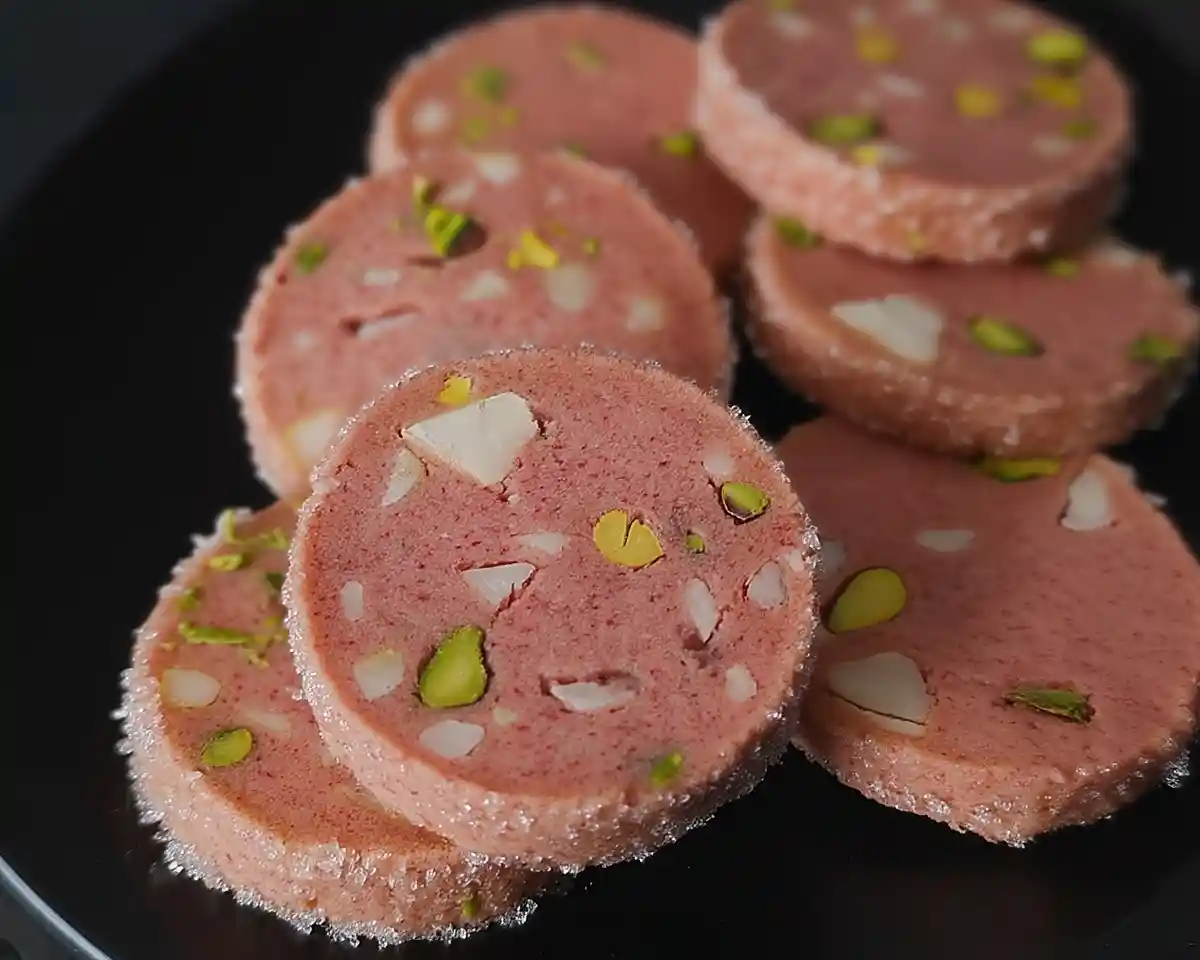
Mortadella cookies are sweet, salami-shaped treats made with almond paste, pistachios, macadamias, and freeze-dried strawberries. Chewy, nutty, and visually stunning, these playful cookies are perfect for holiday swaps or gifting.
Hey, I’m Linda! Welcome to Tasty at Home, where bold flavors meet everyday kitchens. Let me tell you about the first time I saw mortadella cookies at an Italian bakery in Boston—I thought someone had lost their mind putting deli meat next to the cannoli. Then I tasted one.
Mind. Blown. These aren’t savory at all—they’re gorgeous almond paste cookies studded with pistachios and macadamias, shaped to look exactly like slices of Italian mortadella sausage. The pink strawberry-tinted dough mimics the meat, while the nuts play the role of fat pockets. Genius, right?
I’ve spent three weekends perfecting this recipe, tweaking ratios until the texture hit that perfect balance between chewy marzipan and crisp cookie. One batch came out too crumbly (learned my lesson about over-processing the butter), but now it’s spot-on. These cookies turned my holiday cookie swap upside down—everyone wanted the recipe for the “salami cookies.”
Tasty at Home – Where bold flavors meet everyday kitchens.
Table of Contents
What Makes These Mortadella Cookies Special
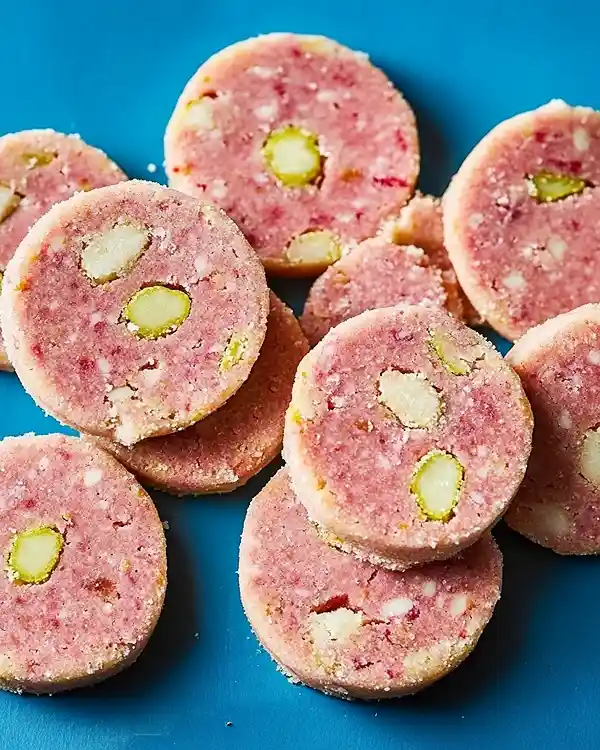
These aren’t your typical slice-and-bake cookies. Mortadella cookies (also called chocolate kolbasa in some regions, though this version skips the chocolate) originated as Italian salami-shaped sweets that cleverly trick the eye.
You’re working with almond paste as the base, which gives you that distinctive marzipan chew, while freeze-dried strawberries create the signature pink “meat” color without artificial dyes.
The technique here mirrors what Thomas Keller teaches about precision in pastry—every ingredient serves a purpose. The sanding sugar coating mimics the rustic exterior of actual sausage, and those carefully chopped nuts? They need to be specific sizes to nail the visual illusion.
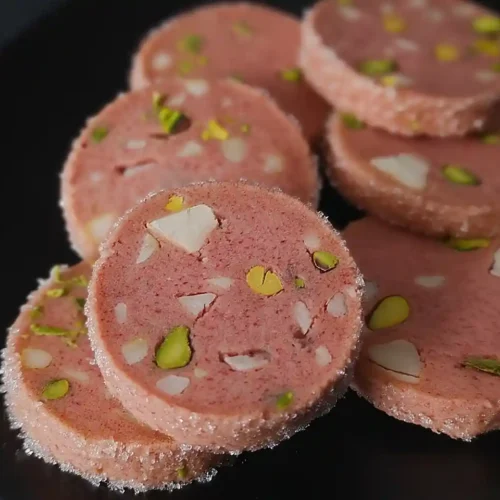
Mortadella Cookies
Equipment
- Food processor
- Fine-mesh strainer
- Parchment paper
- Plastic wrap
- Bench scraper
- Chef’s knife
Ingredients
Main Ingredients
- ½ cup Raw macadamia nuts ¼-inch pieces
- 3 tbsp Raw pistachios ⅛-inch pieces
- 1¼ cups All-purpose flour
- 1½ oz Freeze-dried strawberries
- ½ tsp Kosher salt Diamond Crystal
- ⅛ tsp Baking powder
- ½ cup Unsalted butter chilled, cut into tablespoon pieces
- 4 oz Almond paste
- ⅔ cup Powdered sugar
- ¼ tsp Almond extract
- 1 large Egg white divided, ~30g
- ⅓ cup Sanding sugar
Instructions
- Toss macadamia nuts and pistachios together and set aside.
- Combine flour, freeze-dried strawberries, salt, and baking powder in a food processor and pulse until uniformly pink. Sift through a fine-mesh strainer.
- Process butter, almond paste, powdered sugar, and almond extract until smooth. Add 1 tbsp beaten egg white and process again.
- Add pink flour mixture to the processor and process until a cohesive dough forms.
- Knead in reserved nuts, form a 10-inch log, roll to smooth cylinder.
- Shape the log using parchment and bench scraper to a 12-inch, 2-inch diameter cylinder.
- Wrap in parchment and plastic wrap and refrigerate for 2 hours to chill.
- Brush chilled log with reserved egg white and roll in sanding sugar. Freeze for 15–20 minutes.
- Preheat oven to 300°F and line a baking sheet with parchment.
- Slice log into ¼-inch rounds and bake for 16–19 minutes until edges are golden.
Notes
Ingredient Breakdown: What You’ll Need
Before we dive into measurements, let’s talk quality. Fresh almond paste makes all the difference—look for tubes or cans that feel pliable when you press them, not rock-hard. Your freeze-dried strawberries should be vibrantly red, not faded, which ensures that gorgeous pink hue. Choose raw, unsalted nuts for the cleanest flavor.
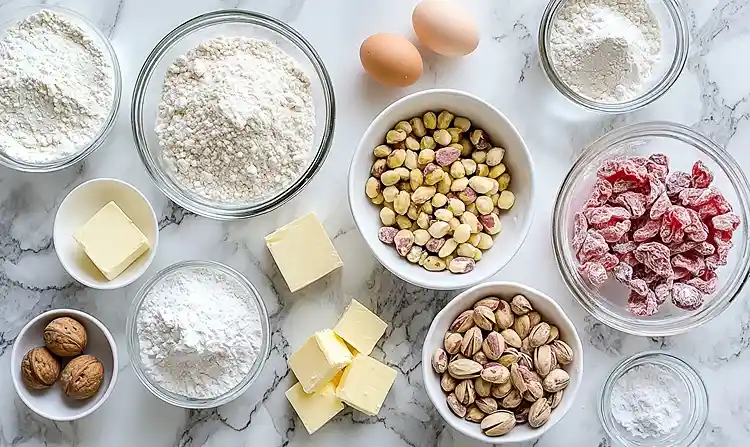
| Ingredient | US Measure | Metric | Notes |
|---|---|---|---|
| Raw macadamia nuts (¼-inch pieces) | ½ cup | 2½ oz / 71g | Creamy texture, mimics fat |
| Raw pistachios (⅛-inch pieces) | 3 tablespoons | ½ oz / 14g | Adds green “spice” flecks |
| All-purpose flour | 1¼ cups | 163g | Structure and snap |
| Freeze-dried strawberries | 1½ oz | 2 cups / 43g | Natural pink coloring |
| Kosher salt (Diamond Crystal) | ½ teaspoon | 3g | Or ¼ tsp Morton |
| Baking powder | ⅛ teaspoon | 0.6g | Subtle lift |
| Unsalted butter, chilled | ½ cup | 113g / 1 stick | Cut into tablespoon pieces |
| Almond paste | 4 oz | 113g | The marzipan magic |
| Powdered sugar | ⅔ cup | 83g | Sweetness and texture |
| Almond extract | ¼ teaspoon | 1.25ml | Amplifies nuttiness |
| Large egg white, divided | 1 | ~30g | Binder and glaze |
| Sanding sugar | ⅓ cup | 60g | Sparkling crust |
Shopping Tips for American Grocery Stores
You’ll find freeze-dried strawberries in the dried fruit aisle or near the granola at stores like Whole Foods, Trader Joe’s, or Target. Almond paste lives in the baking aisle, typically near the pie fillings—don’t confuse it with marzipan, which has higher sugar content. For macadamias, grab them from the bulk bins if available, or buy pre-chopped versions to save time.
Sanding sugar (coarse decorating sugar) sits with cake decorating supplies. If you can’t locate it, substitute with turbinado or demerara sugar for similar crunch.
Bold Add-Ins and Creative Swaps
International Substitutions:
- Almond paste alternative: Combine 1 cup blanched almond flour with ½ cup powdered sugar and 1 tablespoon light corn syrup, then pulse until it forms a paste.
- Macadamia swap: Use blanched almonds or cashews for a different flavor profile.
- Strawberry substitute: Freeze-dried raspberries create a deeper rose color, while freeze-dried cherries give a vintage pink.
Want to experiment? Try white chocolate chips scattered through the dough for a sweeter version, or swap the almond extract for vanilla for milder flavor. Some bakers add a pinch of black sesame seeds to the exterior for an even more authentic “peppercorn” look.
Equipment You’ll Need (Plus DIY Alternatives)
Let’s talk tools. You’ll absolutely need a food processor—this dough comes together through precise grinding and emulsification that hand-mixing can’t replicate. A fine-mesh strainer removes any stubborn strawberry pieces that didn’t pulverize. Beyond that, grab parchment paper, plastic wrap, a bench scraper (or a large spatula), and a sharp chef’s knife.
DIY Alternatives:
- No bench scraper? Use a large offset spatula or the flat edge of a ruler to shape your log.
- Missing a fine-mesh strainer? A flour sifter works in a pinch.
- Can’t find sanding sugar? Pulse regular granulated sugar in your food processor for 10 seconds to create slightly larger crystals.
Step-by-Step Instructions: Building Your Mortadella Cookies
Step 1: Prepare and Combine Your Nuts
Toss the macadamia nuts and pistachios together on a clean cutting board. Gently lift the nut pieces into a small bowl, intentionally leaving behind any powdery bits or dust on the board. Those ultra-fine pieces will make slicing difficult later, so save them for your morning oatmeal instead.
Set the bowl of nuts aside—we’ll incorporate them after the dough comes together.
Step 2: Create the Strawberry-Pink Flour Base
Add flour, freeze-dried strawberries, salt, and baking powder to your food processor bowl. Pulse the mixture, then process continuously for about 45 seconds until the strawberries completely disappear and you’re left with uniformly pink flour. You know you’re done when no white streaks remain.
Sift this pink flour through your fine-mesh strainer onto a 14-inch piece of parchment paper. Discard any stubborn strawberry bits caught in the strainer—they’d create uneven color in your final cookies.
Step 3: Build the Almond Paste Dough
Here’s where Julia Child’s advice about proper emulsification comes into play. Combine butter, almond paste, powdered sugar, and almond extract in your food processor (no need to wash it first—that strawberry residue adds color). Process until completely smooth, pausing once to scrape down the sides.
Beat your egg white with a fork in a small bowl until it breaks up and gets slightly foamy. Measure out exactly 1 tablespoon and add it to the food processor, reserving the rest in the refrigerator—you’ll brush it on later. Process until smooth again, scraping the bowl as needed.
Add all your pink flour mixture to the food processor. Process for about 20 seconds, scraping halfway through, until a cohesive ball of dough forms around the blade. The dough should look like bright pink Play-Doh.
Pro tip: Oops! If your dough seems too dry and crumbly, you might have over-processed the flour mixture, which can reduce moisture. Add another teaspoon of egg white to bring it back together.
Step 4: Incorporate the Nuts for Authentic “Fat Pockets”
Turn your dough out onto the reserved parchment paper. Knead it briefly—maybe 30 seconds—until it’s smooth with no streaks. Pat the dough down to about ¾-inch thickness, creating a flat surface for the next step.
Sprinkle your reserved nut mixture evenly over the top of the dough. Now knead again until every nut piece is evenly distributed throughout the pink dough. Form the dough into a log about 10 inches long, positioning it lengthwise on your parchment.
Roll the log back and forth gently to create a smooth cylinder. Press any large nut pieces that poke out on the surface back into the center, pinching the dough around them to seal. This prevents nuts from falling off during slicing.
Step 5: Shape the Log Using Professional Technique
This step separates amateur cookies from bakery-quality results. Fold the far end of your parchment paper down and over the log, then place your bench scraper over the parchment at a slight downward angle, nearly parallel to your work surface.
Push the scraper firmly along the entire length of the log. This technique forces the dough into a tight, uniform cylinder while compacting it—critical for clean slicing later. You want a log about 12 inches long and just under 2 inches in diameter.
Step 6: Chill the Dough for Easy Slicing
Roll the shaped log tightly in the parchment paper. Wrap it in two layers of plastic wrap, leaving some overhang on both ends. Grasp the excess parchment and plastic on each end, then twist firmly in opposite directions until the dough compacts into a very firm cylinder.
Refrigerate for at least 2 hours, or up to 3 days. The dough needs to be properly chilled for clean slicing—room temperature dough will smoosh under your knife.
Make-ahead magic: Well, you can freeze this log for up to 2 months. Just thaw it overnight in the refrigerator before proceeding to the next step.
Step 7: Create the Sugar-Crusted Exterior
Sprinkle your sanding sugar across a clean work surface or large cutting board. Remove the chilled dough log from the refrigerator and unwrap it completely. Brush the entire surface with your reserved egg white—this acts as glue for the sugar.
Roll the log through the sanding sugar, pressing firmly so the crystals adhere to every spot. Keep rolling until the log is completely coated in sparkling sugar. Transfer to a small cutting board and freeze for 15 to 20 minutes until very firm but not frozen solid.
Step 8: Prepare Your Oven and Baking Sheet
Heat your oven to 300 degrees Fahrenheit. Line a baking sheet with parchment paper and set it aside. The low temperature ensures the cookies bake through without burning their delicate edges.
Step 9: Slice the Cookies into Perfect Rounds
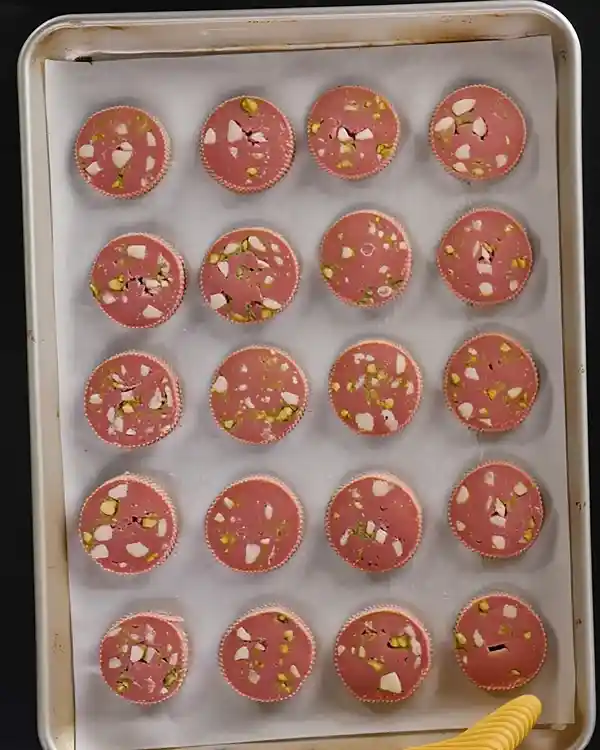
Remove your dough from the freezer. Use your sharpest knife to slice off one end, creating a flat surface. Cut the log into ¼-inch-thick rounds, placing each one on your prepared baking sheet about ½ inch apart—they’ll spread slightly during baking.
As you slice, rotate the log every few cuts to maintain its round shape. If you can’t fit all the slices on one sheet, refrigerate the remaining dough while the first batch bakes.
Technique insight: Thomas Keller emphasizes using a single decisive cut for clean edges—sawing back and forth will drag and deform your cookies.
Step 10: Bake Until Golden at the Edges
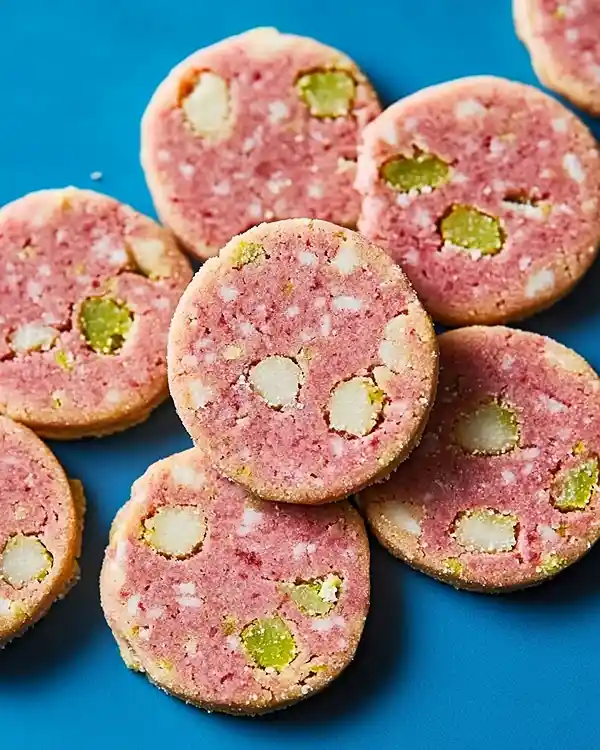
Transfer the baking sheet to your oven’s center rack. Bake for 16 to 19 minutes, until the cookies show just barely golden brown at their edges. The centers should still look slightly pale—they’ll firm up as they cool.
Let the cookies rest on the baking sheet for several minutes before transferring them to a wire rack. Their delicate texture needs this cooling time to set properly. Bake any remaining cookies using the same timing and temperature.
Expert Tips for Perfect Mortadella Cookies Every Time
Temperature is everything. Your butter must be cold when it hits the food processor—this creates the proper texture. Room temperature butter will make the dough greasy and difficult to shape.
Chop nuts uniformly. Those specific sizing instructions (¼-inch for macadamias, ⅛-inch for pistachios) aren’t arbitrary. Uniform pieces create even distribution and authentic visual appeal.
Don’t skip the sifting. Removing strawberry chunks prevents color inconsistencies and ensures smooth slicing.
Use gel food coloring for intensity. Want a deeper pink? Add 2-3 drops of red gel food coloring when you process the butter mixture in Step 3.
Freeze before slicing. That 15-minute freeze in Step 7 firms the log just enough for perfect cuts without being frozen solid.
Creative Variations: Make These Cookies Your Own
Regional American Twist: Peanut Butter Salami Cookies
Replace the almond paste with ½ cup creamy peanut butter and increase powdered sugar to ¾ cup. Use honey-roasted peanuts instead of macadamias for that distinctly American flavor profile. Skip the strawberries and leave the dough its natural beige color.
Holiday Version: Cranberry-White Chocolate Mortadella
Swap freeze-dried strawberries for freeze-dried cranberries and fold in ¼ cup mini white chocolate chips with the nuts. The tartness balances the sweet almond paste beautifully for Thanksgiving and Christmas cookie trays.
Dietary Adaptation: Gluten-Free Mortadella Cookies
Substitute the all-purpose flour with a 1:1 gluten-free baking blend that contains xanthan gum. Add an extra tablespoon of almond paste to compensate for texture differences.
Chocolate Kolbasa Version
For those who love the Eastern European chocolate salami tradition, replace ¼ cup of the flour with Dutch-process cocoa powder. Reduce freeze-dried strawberries to 1 ounce. You’ll get a chocolate-strawberry swirl that’s equally stunning.
Citrus-Pistachio Upgrade
Add 1 teaspoon of lemon zest to the butter mixture and use all pistachios (no macadamias). The bright citrus cuts through the sweetness and pairs phenomenally with afternoon tea.
Storage and Make-Ahead Instructions
Room temperature storage: Keep baked cookies in an airtight container for up to 5 days. They’ll soften slightly over time but remain delicious. Layer them between parchment paper to prevent sticking.
Freezing baked cookies: Flash-freeze cookies on a baking sheet for 1 hour, then transfer to a freezer bag. They’ll keep for 3 months. Thaw at room temperature for 30 minutes before serving.
Dough storage: The unbaked log keeps in the refrigerator for 3 days or the freezer for 2 months. Coat it in sanding sugar just before slicing for the freshest appearance.
| Storage Method | Duration | Instructions |
|---|---|---|
| Countertop (baked) | 5 days | Airtight container, parchment layers |
| Refrigerator (dough) | 3 days | Wrapped in plastic, slice before sugar coating |
| Freezer (dough) | 2 months | Double-wrapped, thaw 24 hours in fridge |
| Freezer (baked) | 3 months | Flash-freeze first, then bag |
Make-ahead strategy: These cookies shine as a prepare-ahead dessert. Shape and chill the log up to 3 days before your event, then slice and bake fresh the morning you need them. Your kitchen will smell incredible, and guests get warm cookies.
Serving Suggestions and Perfect Pairings
Mortadella cookies look stunning arranged on a wooden board with actual charcuterie for a playful dessert board. Slice them slightly thicker (⅜-inch) for a chewier texture when serving alongside espresso or cappuccino.
Pair these almond-forward cookies with:
- Italian dessert wine: Vin Santo or Moscato d’Asti echoes the nutty sweetness
- Strong coffee: The bitter contrast highlights the marzipan flavor
- Fresh berries: Strawberries or raspberries reinforce the fruit notes
- Whipped mascarpone: A light, fluffy dip elevates them to elegant territory
These also make phenomenal edible gifts. Stack them in a clear cellophane bag tied with kitchen twine, and include a tag explaining the “salami” illusion—people love the story as much as the taste.
Mortadella Cookies FAQs
What is mortadella halal?
What is mortadella halal refers to whether the Italian sausage meets Islamic dietary laws. Traditional mortadella contains pork, which isn’t halal. However, these mortadella cookies contain no meat whatsoever—they’re sweet almond paste cookies shaped to look like salami, making them suitable for anyone avoiding pork.
What exactly is mortadella?
What exactly is mortadella is a traditional Italian cold cut from Bologna made with finely ground pork, cubes of pork fat, and spices. In cookie form, bakers recreate this appearance using almond paste dough (pink from strawberries) studded with nuts (mimicking the fat pockets), creating a playful, completely meatless dessert.
What do Italians eat with mortadella?
What do Italians eat with mortadella varies regionally, but the sausage typically appears in panini with cheese and arugula, or sliced thin as antipasto. For mortadella cookies, Italians serve them with espresso or sweet wine during holidays, treating them as conversation-starting novelty sweets rather than everyday cookies.
What’s the best way to eat mortadella?
What’s the best way to eat mortadella cookies is at room temperature alongside coffee or tea. The almond paste texture softens slightly, becoming perfectly chewy. Slice them thicker for softer centers, or thinner for crispier edges. They’re also delightful slightly warmed for 10 seconds in the microwave.
Troubleshooting Common Issues
Problem: Dough is too crumbly to shape The almond paste might have been too dry. Add another tablespoon of egg white, one teaspoon at a time, processing between additions until the dough holds together.
Problem: Cookies spread too much during baking Your dough wasn’t cold enough when it went into the oven. Make sure the log firms up properly in the freezer during Step 7, and refrigerate sliced dough if you’re baking multiple batches.
Problem: Nuts fall out during slicing Those larger pieces need to be pressed into the dough’s interior during Step 4. Take extra time ensuring every protruding nut gets sealed inside before chilling.
Problem: Uneven pink color throughout The freeze-dried strawberries didn’t fully incorporate. Process the flour mixture longer in Step 2—aim for a full minute if needed until absolutely no white streaks remain.
The Science Behind the Perfect Slice-and-Bake
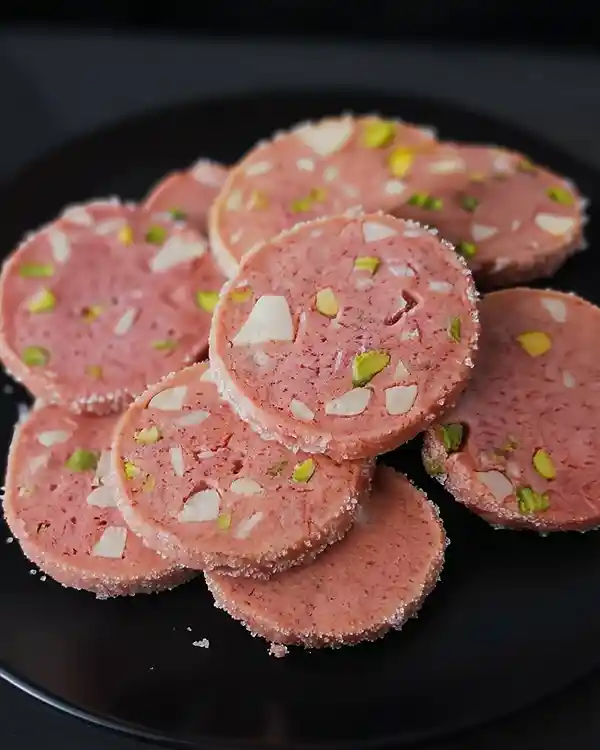
Understanding why these cookies work helps you troubleshoot and adapt. Almond paste contains almond flour bound with sugar and sometimes corn syrup, creating a cohesive, pliable base that holds its shape better than standard cookie dough. The minimal baking powder provides just enough lift to keep the cookies tender without puffing them into unrecognizable shapes.
The sanding sugar coating does double duty—it adds textural contrast and locks in moisture during baking. This explains why these cookies stay chewy inside while developing that delicate crisp exterior.
Chilling and freezing at specific stages isn’t optional fussiness. Cold fat (from the butter and almond paste) prevents spreading, while the frozen exterior during slicing means your knife cuts cleanly instead of dragging through soft dough.
Why These Cookies Win Every Cookie Swap
Man, these mortadella cookies deliver serious visual impact. Every single person who sees them does a double-take, which makes them ideal for potlucks, holiday parties.
The flavor profile hits that sophisticated sweet spot between “interesting enough for adults” and “approachable enough for kids.” You’re not dealing with weird ingredients or acquired tastes. It’s just buttery, nutty, fruit-kissed goodness in a clever package.
Plus, they’re make-ahead champions. Shape the logs this weekend, freeze them, and you’ve got impressive homemade cookies ready to slice and bake whenever you need them over the next two months. That’s what I call kitchen efficiency.
Conclusion: Your New Signature Cookie
These mortadella cookies changed my whole cookie game. They’re now my go-to when I want to impress without spending hours decorating. The pink color comes from real fruit, the texture hits that perfect chewy-crisp balance, and people absolutely lose their minds when they realize they’re looking at cookies shaped like Italian sausage.
Make a batch this weekend and let me know how they turn out! Drop a comment below if you tried any of the variations—I especially want to hear about the chocolate kolbasa version. Happy baking!
