
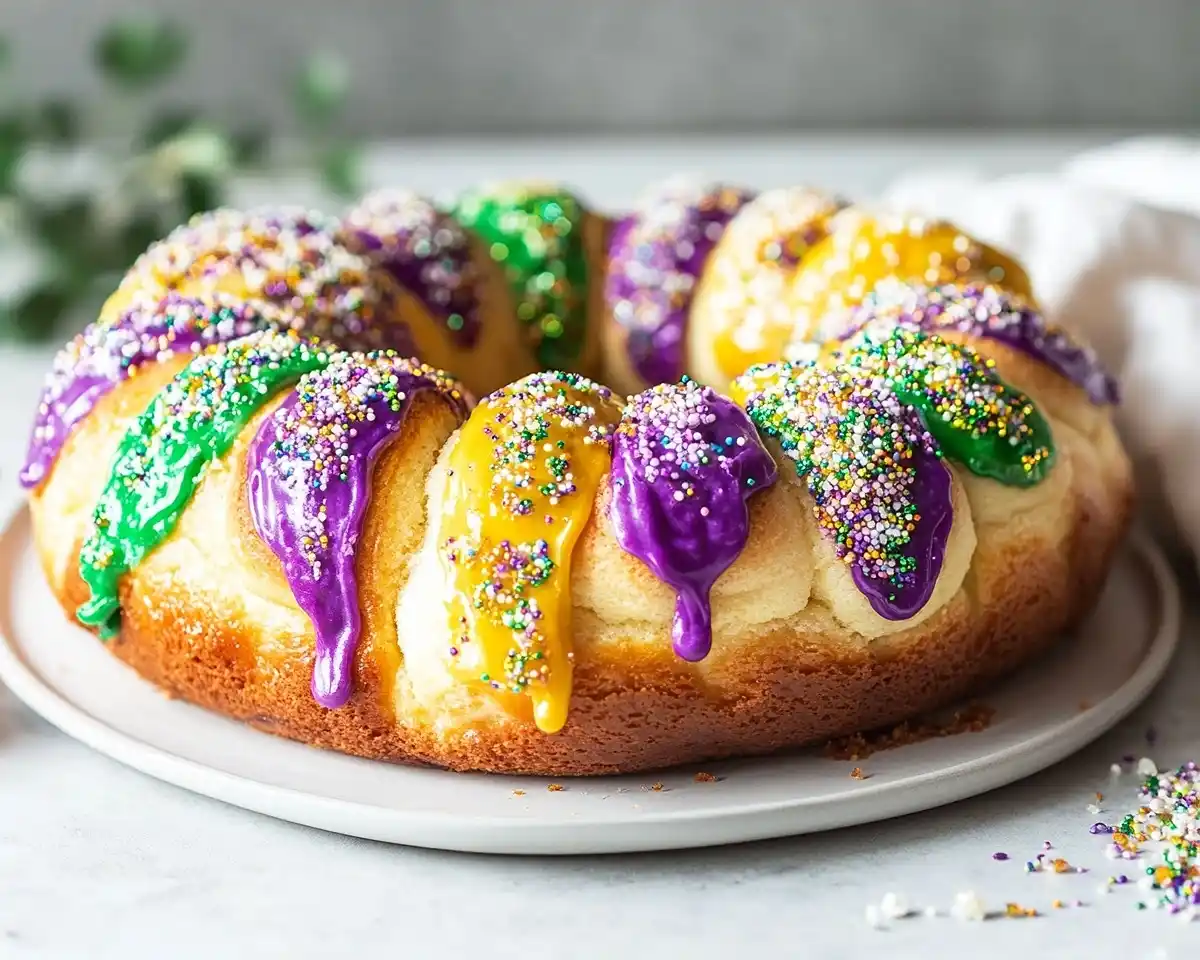
King Cake recipe or Mardi Gras King Cake with brioche dough and cinnamon or cream cheese filling. Perfect homemade Mardi Gras cake for your celebration.
Hey, I’m Linda! Welcome to Tasty at Home, where bold flavors meet everyday kitchens.
My first Mardi Gras in New Orleans changed everything. I watched a local baker twist golden dough into an oval masterpiece, and the scent of cinnamon and butter filled the entire French Quarter block. That moment? Pure magic.
I came home determined to master the best king cake recipe myself. Spoiler alert: my first attempt looked more like a deflated football than a festive crown. But after testing this recipe seventeen times (yes, seventeen), I finally cracked the code to bakery-quality results.
This homemade King Cake delivers that perfect balance—pillowy brioche dough, your choice of cinnamon or cream cheese filling, and those iconic purple, green, and gold colors that scream celebration. Plus, it makes two cakes, so you can share the joy or freeze one for later.
Tasty at Home – Where bold flavors meet everyday kitchens.
Table of Contents
What Makes This King Cake Recipe Special
This recipe stands apart because it uses a true brioche-style dough enriched with butter, eggs, and milk. The result? A tender, slightly sweet bread that stays moist for days.
Most store-bought versions taste dry by day two. Not this one. The secret lies in the milk-and-butter mixture and proper kneading technique, which creates that signature pillowy texture.
You also get complete control over your filling. Choose between classic cinnamon sugar or rich cream cheese—or make both since this recipe yields two gorgeous cakes.
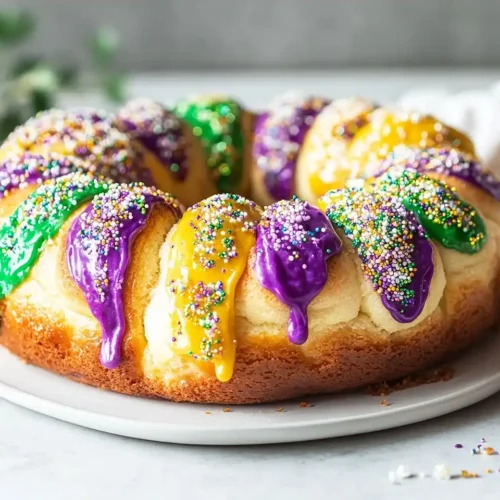
King Cake
Equipment
- Stand mixer with dough hook
- Baking sheet
- Parchment paper
- Rolling Pin
- Pizza Cutter
- Digital thermometer
Ingredients
Dough
- 1 cup Whole milk Warm, not hot
- ¼ cup Salted butter Plus extra for greasing
- 1 ½ tsp Salt Enhances flavor
- ⅔ cup Warm water 110-115°F
- ½ cup Granulated sugar Divided use
- 1 Tbsp Active dry yeast Check freshness
- 2 Large eggs Beaten, room temp
- 2 tsp Vanilla extract Pure preferred
- 5 to 5 ½ cups All-purpose flour Spooned and leveled
Cinnamon Filling
- ⅔ cup Brown sugar Packed
- ⅓ cup Granulated sugar
- ½ cup All-purpose flour Helps bind
- 2 tsp Ground cinnamon Fresh preferred
- 4 Tbsp Salted butter Melted
Cream Cheese Filling
- 8 oz Cream cheese Softened
- 2 cups Powdered sugar Sifted
- 2 Tbsp Salted butter Softened
- 1 tsp Vanilla extract
Frosting
- 2 cups Powdered sugar Sifted
- 3 Tbsp Milk Whole milk best
- 1 Tbsp Salted butter Melted
- 1 tsp Lemon juice Fresh squeezed
- 1 tsp Vanilla extract
Decorations
- Purple, green, gold sanding sugar Mardi Gras colors
- 2 Plastic baby figurines Traditional surprise
Instructions
- Heat milk and butter until butter melts. Stir in salt and cool to 120-130°F.
- Activate yeast by combining warm water, sugar, and yeast. Let foam for 5-10 minutes.
- Mix milk mixture, sugar, eggs, vanilla, and flour. Knead dough until smooth and elastic.
- Place dough in oiled bowl, cover, and let rise 1-2 hours until doubled.
- Prepare cinnamon or cream cheese filling while dough rises.
- Divide dough, roll, fill, twist into ropes, shape into ovals, and let rise 30-45 minutes.
- Bake at 350°F for 25-30 minutes until golden and cooked through.
- Frost with sugar, milk, butter, lemon juice, and vanilla. Decorate with purple, green, and gold sugar. Insert baby figurine.
Notes
Ingredients You’ll Need
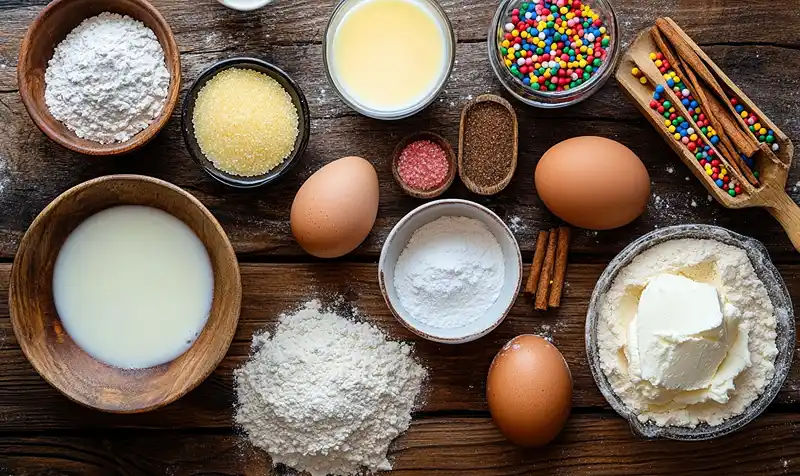
Before we dive into measurements, let’s talk quality. Use whole milk for richness and salted butter for depth of flavor. Fresh active dry yeast is essential—check the expiration date before you start. For the best rise, your eggs should be at room temperature.
| Ingredient | US Measure | Metric | Notes |
|---|---|---|---|
| For the Dough | |||
| Whole milk | 1 cup | 240 ml | Warm, not hot |
| Salted butter | 1/4 cup | 57 g | Plus extra for greasing |
| Salt | 1 1/2 teaspoons | 9 g | Enhances flavor |
| Warm water | 2/3 cup | 160 ml | 110-115°F |
| Granulated sugar | 1/2 cup | 100 g | Divided use |
| Active dry yeast | 1 Tablespoon | 9 g | Check freshness |
| Large eggs | 2 | — | Beaten, room temp |
| Vanilla extract | 2 teaspoons | 10 ml | Pure preferred |
| All-purpose flour | 5 to 5 1/2 cups | 705-776 g | Spooned and leveled |
| Cinnamon Filling (Full Batch) | |||
| Brown sugar | 2/3 cup | 145 g | Packed |
| Granulated sugar | 1/3 cup | 67 g | — |
| All-purpose flour | 1/2 cup | 68 g | Helps bind |
| Ground cinnamon | 2 teaspoons | 5 g | Fresh preferred |
| Salted butter | 4 Tablespoons | 57 g | Melted |
| Cream Cheese Filling (Full Batch) | |||
| Cream cheese | 8 ounces | 226 g | Softened |
| Powdered sugar | 2 cups | 240 g | Sifted |
| Salted butter | 2 Tablespoons | 28 g | Softened |
| Vanilla extract | 1 teaspoon | 5 ml | — |
| For the Frosting | |||
| Powdered sugar | 2 cups | 240 g | Sifted |
| Milk | 3 Tablespoons | 45 ml | Whole milk best |
| Salted butter | 1 Tablespoon | 14 g | Melted |
| Lemon juice | 1 teaspoon | 5 ml | Fresh squeezed |
| Vanilla extract | 1 teaspoon | 5 ml | — |
| Decorations | |||
| Purple, green, gold sanding sugar | As needed | — | Mardi Gras colors |
| Plastic baby figurines | 2 | — | Traditional surprise |
Shopping Tips for American Grocery Stores
You’ll find active dry yeast in the baking aisle near flour. Look for Fleischmann’s or Red Star brands—both work beautifully. Sanding sugar in Mardi Gras colors appears in most stores starting in January, but you can order it online year-round.
Can’t find colored sugar? No problem. Use regular granulated sugar and add a few drops of food coloring, then let it dry on parchment paper. The cream cheese filling requires full-fat brick-style cream cheese, not the spreadable kind.
Bold Add-Ins and Creative Variations
Want to level up your Mardi Gras cake? Try adding 1/2 cup of finely chopped pecans to the cinnamon filling for Southern flair. Some folks swirl in raspberry preserves alongside the cream cheese for a fruity twist.
You can also experiment with the frosting. Add 1/2 teaspoon of almond extract instead of vanilla for a subtle nutty note. For chocolate lovers, replace 1/4 cup of powdered sugar with cocoa powder in the frosting.
Ingredient Substitutions
International readers can substitute plain flour for all-purpose flour. If you can’t find salted butter, use unsalted and add an extra 1/4 teaspoon of salt to the dough. Instant yeast works too—skip the proofing step and add it directly to the dry ingredients.
For dairy-free versions, use almond milk and vegan butter substitutes. The texture changes slightly, but you still get a delicious result. Gluten-free? Try a 1:1 baking flour blend, though the texture won’t be quite as airy.
Equipment You’ll Need
Here’s what you should gather before starting. A stand mixer with a dough hook saves serious arm strength, but you can absolutely knead by hand—it just takes 8-10 minutes instead of 5.
You’ll need two large baking sheets, parchment paper, and a rolling pin. A pizza cutter makes dividing dough incredibly easy. Don’t have one? A sharp knife works fine.
A digital thermometer helps check dough temperature and doneness. Aim for 190-195°F in the center when baking. No thermometer? The cake should sound hollow when you tap the bottom.
DIY Equipment Alternatives
Missing a stand mixer? Well, a large bowl and wooden spoon get the job done. Your forearms will get a workout, but the dough turns out just as good. Julia Child kneaded by hand for years, and her breads were legendary.
Use a wine bottle as a rolling pin if needed. Just make sure it’s clean and smooth. For the baking sheets, any flat oven-safe pan works—even a large pizza pan or upside-down rimmed baking sheet.
Step-by-Step Instructions
Step 1: Prepare the Dough Base
Heat your milk and butter together in a microwave-safe bowl for 60-90 seconds until the butter melts completely. Stir in the salt, then set aside to cool until it reaches about 120-130°F. You know it’s ready when you can comfortably hold your finger in the mixture for several seconds without burning.
This temperature is crucial—too hot and you’ll kill the yeast, too cold and it won’t activate properly. Let me tell you, I learned this the hard way when my first batch refused to rise because I was too impatient.
Step 2: Activate the Yeast
Combine warm water (110-115°F), about 1 tablespoon of sugar, and all the yeast in a separate bowl. Stir gently, then walk away for 5-10 minutes. The mixture should become foamy and smell slightly beer-like.
If nothing happens after 10 minutes, your yeast is dead. Toss it and start over with fresh yeast. This step guarantees your dough will rise beautifully later.
Step 3: Mix and Knead the Dough
Once your yeast looks like cappuccino foam, add the cooled milk mixture, remaining sugar, beaten eggs, vanilla extract, and 1 cup of flour. Mix everything until smooth. Now comes the fun part—add flour one cup at a time while the dough hook kneads on medium speed.
Stop when the dough starts pulling away from the bowl sides but still feels soft and slightly tacky. You might need only 5 cups or the full 5 1/2 cups—flour absorption varies based on humidity and brand. Knead for 5 minutes by machine or 8-10 minutes by hand until the dough feels elastic and smooth.
Thomas Keller emphasizes that proper gluten development creates that signature tender crumb. You’ll feel the texture transform under your hands—it’s incredibly satisfying.
Step 4: First Rise
Turn the dough onto a lightly floured surface and knead a few times by hand to shape it into a smooth ball. Clean your bowl, dry it, then rub a thin layer of oil around the inside. Return the dough to the bowl and turn it once to coat all sides with oil.
Cover tightly with plastic wrap and place in a warm, draft-free spot. I use my oven with just the light on—it creates the perfect environment. Let the dough rise for 1-2 hours until doubled in size.
You’ll know it’s ready when you poke it with a finger and the indentation stays. Man, oh man, watching dough rise never gets old.
Step 5: Prepare Your Filling
While the dough rises, make your filling. For cinnamon filling, mix brown sugar, granulated sugar, flour, cinnamon, and melted butter in a bowl until crumbly. The flour helps the filling stick to the dough instead of oozing out during baking.
For cream cheese filling, beat softened cream cheese, powdered sugar, softened butter, and vanilla until completely smooth. No lumps allowed here. Use half of whichever filling you choose per cake, or make both fillings and create one of each.
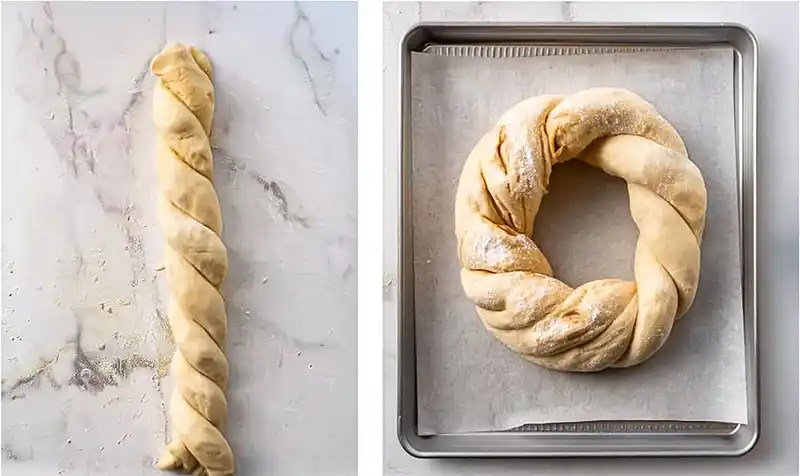
Step 6: Shape the King Cakes
Line two baking sheets with parchment paper. Once your dough has doubled, punch it down firmly with your fist to release air bubbles. Divide the dough in half—each piece becomes one king cake.
Roll one portion into a large rectangle on a floured surface, roughly 10×16 inches. Use a pizza cutter to divide it lengthwise into two long strips. Crumble cinnamon filling or spread cream cheese filling evenly across both strips, leaving a 1/2-inch border on the edges.
Roll each strip lengthwise into a long cylinder, just like making cinnamon rolls. Now twist the two logs together into a rope braid—it looks tricky but happens naturally as you work. Transfer to your prepared baking sheet and shape into an oval, pinching the ends together firmly so they don’t separate during baking.
Repeat with the remaining dough and filling. Cover both cakes loosely with plastic wrap and let rise for 30-45 minutes until puffy.
Step 7: Bake to Golden Perfection
Preheat your oven to 350°F while the shaped cakes rise. Once puffy, slide them into the oven and bake for 25-30 minutes until golden brown all over. The cakes should reach 190-195°F in the center on a digital thermometer.
Watch for that gorgeous golden color and the amazing scent that fills your kitchen—it’s like walking past a New Orleans bakery on a February morning. Remove from the oven and let cool completely on the baking sheets before frosting. Oops, I once frosted a warm cake and the icing melted into a sticky puddle.
Step 8: Frost and Decorate
Beat powdered sugar, milk, melted butter, lemon juice, and vanilla in a medium bowl until smooth. The frosting should be thick enough to coat a spoon but still pourable. Add a splash more milk if it’s too thick, or more powdered sugar if too thin.
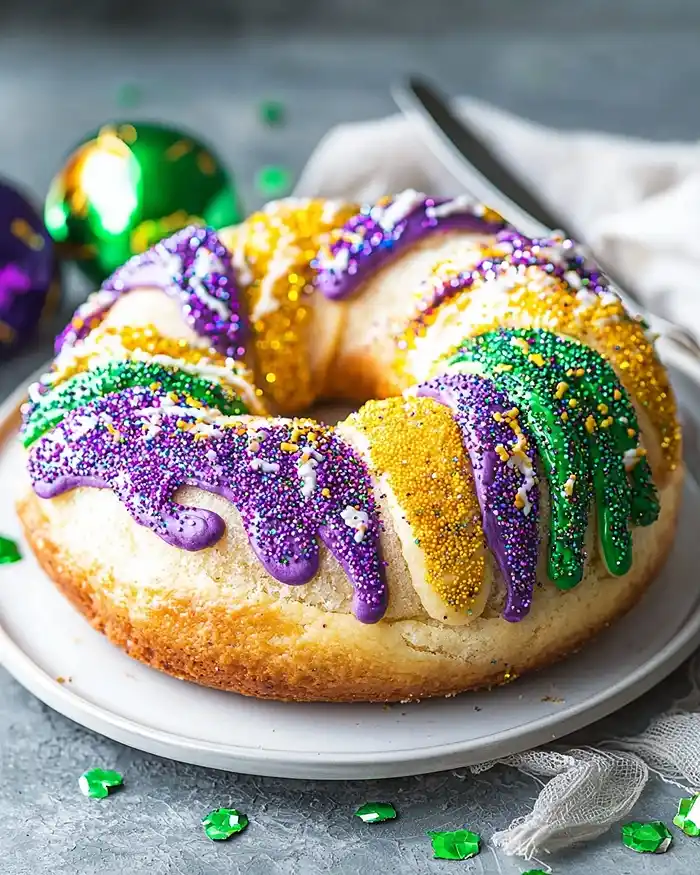
Here’s where tradition comes in—push a plastic baby figurine deep into each cake from the bottom so it’s completely hidden. Drizzle frosting generously over both king cakes, using a spatula to spread it evenly. While the frosting is still wet, sprinkle alternating bands of purple, green, and gold sanding sugar in sections around each oval.
The colors represent justice (purple), faith (green), and power (gold). Let the frosting set for about 15 minutes before slicing.
Expert Tips for Bakery-Quality Results
Temperature matters more than anything else when working with yeast dough. Keep your ingredients around 75-80°F for optimal rise. If your kitchen is cold, warm the oven to 200°F, turn it off, then let your dough rise inside.
Don’t skip the second rise after shaping. This step makes the difference between dense bread and pillowy cake. The extra 30-45 minutes gives you that light, airy texture everyone craves.
Use the windowpane test to check if you’ve kneaded enough. Stretch a small piece of dough between your fingers—if it forms a thin, translucent membrane without tearing, you’re done. If it tears immediately, keep kneading.
For the cleanest slices, use a serrated knife and wipe it clean between cuts. This prevents the frosting from smearing everywhere and keeps those colorful sugar bands distinct.
Regional and Dietary Variations
Gulf Coast Style: Add 1/2 cup of finely chopped pralines to the cinnamon filling and use bourbon in place of vanilla extract in the frosting. This variation celebrates Louisiana’s love affair with pecans and spirits.
Chocolate Lover’s Dream: Replace the traditional filling with a mixture of 1 cup chocolate chips, 1/4 cup cocoa powder, and 3 tablespoons melted butter. Drizzle chocolate ganache over the top instead of white frosting.
Berry-Filled Version: Spread 1/2 cup of raspberry or blueberry preserves alongside the cream cheese filling. The tartness cuts through the sweetness beautifully and adds gorgeous color when you slice it.
Gluten-Free Adaptation: Substitute a 1:1 gluten-free flour blend for regular flour. Add 1 teaspoon of xanthan gum if your blend doesn’t include it. The texture won’t be identical, but you still get a festive, delicious cake.
Make-Ahead Holiday Version: Prepare the dough through the first rise, punch it down, then refrigerate overnight. The next day, let it come to room temperature for 30 minutes before shaping. This slow fermentation develops incredible flavor depth.
Storage and Make-Ahead Instructions
Store your Mardi Gras cake in an airtight container or wrapped tightly in plastic wrap at room temperature. It stays fresh for 3-4 days, though the frosting may absorb into the cake slightly over time.
You can freeze unfrosted king cakes for up to 3 months. Wrap each cake tightly in plastic wrap, then aluminum foil. Thaw overnight in the refrigerator, then bring to room temperature before frosting.
For best results, freeze the filling separately and the baked, cooled cakes without filling. Thaw, slice lengthwise, add fresh filling, and reassemble before serving.
| Storage Method | Duration | Instructions |
|---|---|---|
| Room temperature | 3-4 days | Airtight container, away from heat |
| Refrigerated | 5-6 days | Wrapped in plastic, but may dry slightly |
| Frozen (unfrosted) | 3 months | Double-wrapped in plastic and foil |
| Frozen (frosted) | 2 months | Thaw in refrigerator overnight |
Perfect Pairings and Serving Suggestions
Serve your homemade King Cake with strong chicory coffee for an authentic New Orleans experience. The bitter coffee balances the sweet frosting perfectly. You might also enjoy it alongside our ultimate Salisbury steak recipe for a complete Southern-inspired feast.
For a Mardi Gras party spread, pair slices with Hurricane cocktails or champagne punch. The cake also works beautifully as a dessert after our hearty one-pot beef pasta with garlic butter.
Kids love finding the hidden baby figurine, and whoever discovers it in their slice traditionally hosts the next year’s party or buys the next king cake. Some families make it an annual competition with elaborate crowns for the winner.
Try warming individual slices for 10-15 seconds in the microwave before serving. The frosting gets slightly melty and the filling becomes gooey—absolutely heavenly.
king cake recipe FAQs
Can I use instant yeast instead of active dry yeast?
Yes, instant yeast works perfectly in this king cake recipe. Use the same amount but skip the proofing step—add it directly to the dry ingredients. Your dough will rise slightly faster, so watch for the doubled-size cue rather than relying on exact timing.
What’s the best way to keep king cake fresh?
The best way to keep king cake fresh is storing it in an airtight container at room temperature for up to 4 days. Avoid refrigeration unless you live in a very humid climate, as it can dry out the bread. For longer storage, freeze unfrosted cakes wrapped tightly in plastic wrap and foil.
How do I know when my king cake dough has risen enough?
Your king cake dough has risen enough when it doubles in size and a finger poke leaves an indentation that stays. This typically takes 1-2 hours depending on your kitchen temperature. If the dough springs back immediately, it needs more time.
Can you make king cake dough the night before?
You can absolutely make king cake dough the night before—in fact, it improves the flavor. After the first rise, punch down the dough, cover it tightly, and refrigerate overnight. The next morning, let it sit at room temperature for 30 minutes before shaping and filling.
Celebrate Mardi Gras with Homemade Magic
This king cake recipe brings genuine New Orleans tradition straight to your kitchen. The tender brioche dough, sweet filling options, and festive decorations create a centerpiece worthy of any celebration.
Remember that first failed attempt I mentioned? It taught me patience and precision—two essential skills for any baker. Now you get to skip the learning curve and jump straight to success.
Slice into your homemade Mardi Gras cake and watch faces light up when someone discovers the hidden baby. That moment of surprise and laughter? That’s what exceptional home cooking from Tasty at Home is all about.
Try this recipe and drop a comment below telling me which filling you chose! I’d love to hear about your Mardi Gras celebrations and any creative variations you discover.
For more festive recipes that bring people together, explore our collection of easy crowd-pleasing taco soup variations perfect for casual gatherings year-round.
